
Computational Genomics & NGS

WGS & WES

AI-Powered Variant Discovery, Clinical Genomics & Precision Medicine Analytics
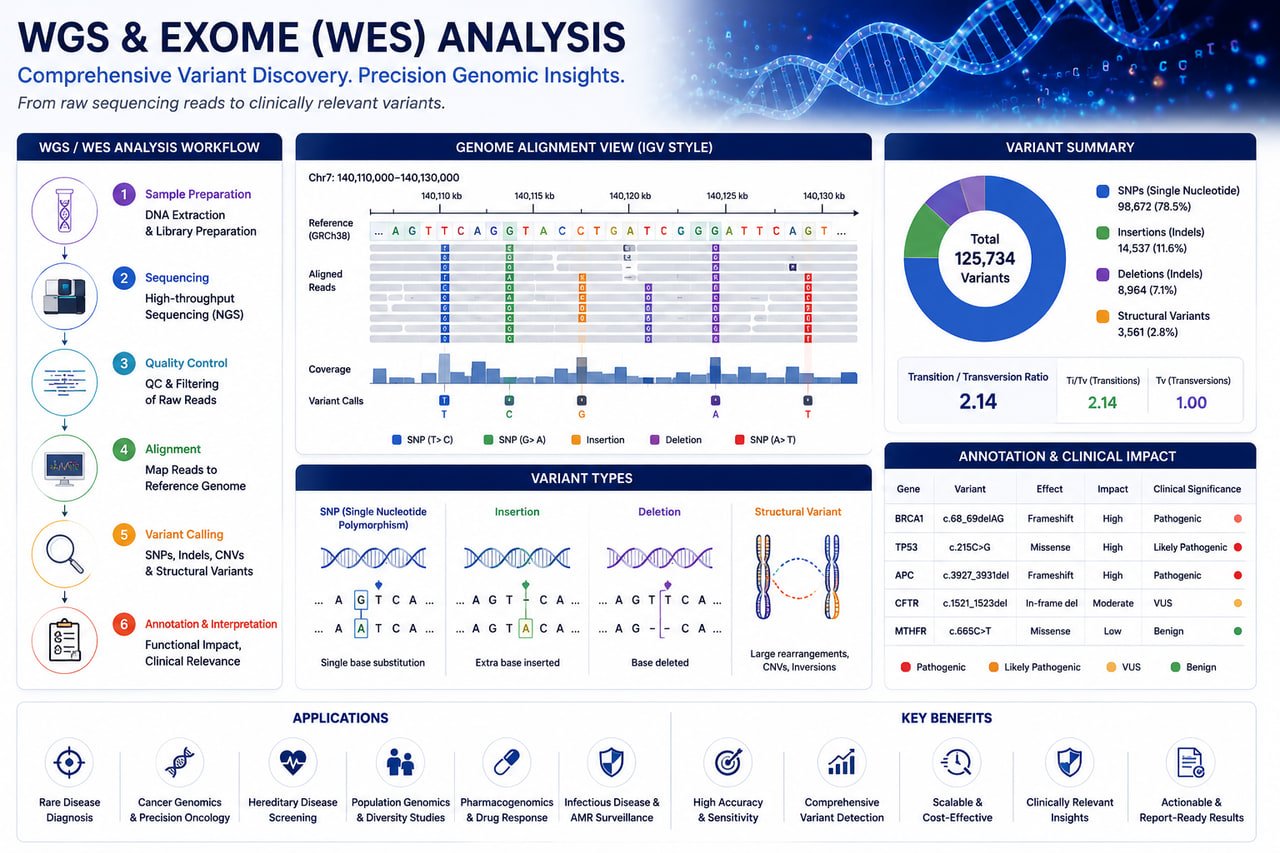
WGS & WES

RASA Life Science Informatics provides advanced Whole Genome Sequencing (WGS) and Whole Exome Sequencing (WES) data analysis services to support genomic research, clinical genomics, rare disease investigations, cancer genomics, biomarker discovery, and precision medicine programs.

Our scalable bioinformatics workflows enable comprehensive identification, annotation, interpretation, and prioritization of genomic variants from large-scale sequencing datasets. Using industry-standard tools and AI-assisted analytics, we help pharmaceutical companies, biotechnology organizations, hospitals, diagnostic laboratories, CROs, and academic researchers transform sequencing data into actionable biological and clinical insights.

We support data generated from Illumina, Oxford Nanopore, PacBio HiFi, and hybrid sequencing platforms through secure, reproducible, and cloud-ready computational pipelines.

Service Offerings

WGS & WES Analysis Services

Whole Genome Sequencing (WGS)

Comprehensive analysis of coding and non-coding regions across the entire genome.

  • โœ“Genome-wide variant discovery
  • โœ“SNP and InDel identification
  • โœ“Structural variant analysis
  • โœ“Copy Number Variation (CNV) analysis
  • โœ“Mobile element insertion detection
  • โœ“Population genomics analysis

Whole Exome Sequencing (WES)

Focused analysis of protein-coding regions associated with disease and clinical phenotypes.

  • โœ“Exonic variant detection
  • โœ“Rare disease variant discovery
  • โœ“Candidate gene prioritization
  • โœ“Mendelian disease analysis
  • โœ“Trio and family-based analysis
  • โœ“Clinical variant interpretation

Variant Annotation & Interpretation

Comprehensive biological and clinical interpretation of genomic variants.

  • โœ“Functional annotation
  • โœ“Pathogenicity prediction
  • โœ“ACMG-guided variant classification
  • โœ“Clinical significance assessment
  • โœ“Population frequency analysis
  • โœ“Literature-based evidence review

Cancer Genomics Analysis

Advanced somatic variant detection and tumor profiling workflows.

  • โœ“Somatic mutation analysis
  • โœ“Tumor-normal comparison
  • โœ“Driver mutation identification
  • โœ“Tumor mutational burden (TMB)
  • โœ“Mutational signature analysis
  • โœ“Precision oncology support

Rare Disease Genomics

Identification and prioritization of disease-causing genetic variants.

  • โœ“Rare variant discovery
  • โœ“Family-based analysis
  • โœ“Candidate gene prioritization
  • โœ“Phenotype-driven interpretation
  • โœ“Clinical reporting support
Capabilities

Key Features

โœ“Whole Genome & Whole Exome Expertise
โœ“AI-Assisted Variant Prioritization
โœ“Clinical & Research Genomics Support
โœ“Structural Variant & CNV Analysis
โœ“Rare Disease & Cancer Genomics
โœ“Cloud-Ready Reproducible Pipelines
โœ“Publication-Ready Reports & Visualizations
Deliverables

Deliverables

Variant Analysis Reports

โœ“SNP & InDel Reports
โœ“Structural Variant Reports
โœ“CNV Analysis Reports
โœ“Annotated VCF Files
โœ“Candidate Variant Lists

Clinical Interpretation Outputs

โœ“ACMG Classification Reports
โœ“Pathogenicity Assessments
โœ“Disease Association Reports
โœ“Clinical Variant Summaries

Visualization & Reporting

โœ“Genome-Wide Variant Summaries
โœ“Mutation Distribution Plots
โœ“CNV Visualizations
โœ“Publication-Ready Figures
โœ“Comprehensive Scientific Reports
Applications

Applications

Rare Disease Research

Identification of causative genetic variants associated with inherited disorders.

Cancer Genomics

Somatic mutation profiling and precision oncology applications.

Precision Medicine

Genomic analysis supporting personalized therapeutic strategies.

Clinical Genomics

Variant interpretation and translational genomics research.

Population Genomics

Large-scale genomic variation studies and cohort analysis.

Biomarker Discovery

Identification of genomic biomarkers for diagnosis and prognosis.

Technology

Technologies & Platforms

Variant Calling

GATK
DeepVariant
FreeBayes
bcftools

Annotation & Interpretation

ANNOVAR
Ensembl VEP
ClinVar
OMIM
gnomAD

Structural Variant Analysis

Manta
Delly
LUMPY
GRIDSS

Copy Number Analysis

CNVkit
Control-FREEC
ExomeDepth

Infrastructure

Nextflow
Snakemake
Docker
AWS
Google Cloud
HPC Clusters
Highlights

Representative Analysis Outputs

Variant Discovery

Identification of SNPs, InDels, structural variants, and CNVs.

Rare Disease Investigation

Prioritization of clinically relevant disease-causing variants.

Cancer Genomics Profiling

Detection of somatic mutations and actionable genomic alterations.

Precision Medicine Support

Genomic insights supporting personalized treatment decisions.

Biomarker Discovery

Identification of predictive and prognostic genomic markers.

Why RASA

Why Choose RASA?

AI-Assisted Bioinformatics

Machine learning-enabled workflows for biomarker discovery, variant prioritization, and predictive genomics.

Multi-Platform Expertise

Support for Illumina, Oxford Nanopore, PacBio HiFi, and 10x Genomics platforms.

End-to-End Analysis

From raw sequencing data to biological interpretation and publication-ready reports.

Cloud-Ready Infrastructure

Deployable on AWS, Google Cloud, HPC clusters, and secure on-premise environments.

Reproducible Workflows

Built using Nextflow, Snakemake, Docker, and Singularity for enterprise-grade bioinformatics operations.

Service FAQ

Frequently Asked Questions

Whole Genome Sequencing (WGS) analyzes the complete DNA sequence of an organism, including both coding and non-coding regions of the genome. In contrast, Whole Exome Sequencing (WES) focuses only on protein-coding regions (exons), which represent approximately 1โ€“2% of the genome but contain the majority of known disease-causing mutations.
WGS provides a more comprehensive view of genomic variation, while WES offers a cost-effective approach for identifying clinically relevant variants associated with inherited disorders, rare diseases, and cancer.

RASA Life Science Informatics offers comprehensive WGS and WES bioinformatics services including:
Quality Control & Data Processing
Read Alignment & Mapping
Variant Calling
Variant Annotation
Clinical Variant Interpretation
Structural Variant Analysis
Copy Number Variation (CNV) Analysis
Rare Disease Genomics
Cancer Genomics
Pharmacogenomics
Precision Medicine Analytics
Biomarker Discovery
Our workflows support research, clinical genomics, and translational medicine projects.

Our analysis pipelines can identify a wide range of genomic alterations, including:
Single Nucleotide Polymorphisms (SNPs)
Single Nucleotide Variants (SNVs)
Insertions and Deletions (InDels)
Copy Number Variations (CNVs)
Structural Variants (SVs)
Gene Fusions
Mobile Element Insertions
Regulatory Variants
Loss-of-Function Variants
Rare Disease-Causing Mutations
The specific variants detected depend on sequencing depth, platform, and study design.

Yes. We perform comprehensive clinical variant interpretation using internationally recognized guidelines and databases. Variants are evaluated based on pathogenicity, population frequency, disease association, inheritance patterns, and published scientific evidence.
Our interpretation workflows support rare disease research, clinical genomics studies, cancer genomics projects, and precision medicine applications.

Yes. Variant interpretation follows the recommendations of the American College of Medical Genetics and Genomics (ACMG) whenever appropriate. Variants may be classified as:
Pathogenic
Likely Pathogenic
Variant of Uncertain Significance (VUS)
Likely Benign
Benign
This classification framework helps prioritize clinically relevant variants for downstream investigation.

Our annotation workflows integrate information from leading genomic and clinical databases, including:
ClinVar
OMIM
gnomAD
HGMD
Ensembl VEP
ANNOVAR
dbSNP
COSMIC
OncoKB
PharmGKB
These resources help improve variant prioritization and biological interpretation.

Yes. Whole Genome Sequencing and Whole Exome Sequencing are widely used to identify disease-causing mutations associated with inherited and rare genetic disorders. Our workflows support:
Trio Analysis
Family-Based Sequencing Studies
Mendelian Disease Analysis
Candidate Gene Prioritization
Phenotype-Driven Variant Interpretation

WGS and WES are commonly used in oncology research to identify:
Somatic Mutations
Driver Mutations
Tumor-Specific Variants
Actionable Biomarkers
Tumor Mutational Burden (TMB)
Mutational Signatures
These analyses support precision oncology and translational cancer research programs.

Yes. Because WGS covers the entire genome, it can identify variants located in non-coding regions, regulatory elements, structural variants, and complex genomic rearrangements that may not be captured by WES.
For comprehensive genomic characterization, WGS is often considered the most informative sequencing approach.

We commonly support:
FASTQ Files
BAM Files
CRAM Files
VCF Files
gVCF Files
Phenotype Data
Clinical Metadata
Our team can also accommodate custom project-specific formats.

Our workflows utilize industry-standard tools including:
Alignment & Processing
BWA-MEM
Bowtie2
SAMtools
Picard
Variant Calling
GATK
DeepVariant
FreeBayes
bcftools
Structural Variant Analysis
Manta
Delly
LUMPY
GRIDSS
Annotation & Interpretation
ANNOVAR
Ensembl VEP
ClinVar
OMIM
Workflow Infrastructure
Nextflow
Snakemake
Docker
AWS
Google Cloud

Typical project deliverables include:
Quality Control Reports
Variant Calling Reports
Annotated VCF Files
Candidate Variant Lists
Clinical Interpretation Reports
CNV Analysis Reports
Structural Variant Reports
Pathway Analysis Results
Publication-Ready Figures
Comprehensive Scientific Reports
Deliverables can be customized according to research objectives and regulatory requirements.

Yes. We routinely integrate genomic data with:
RNA-Seq
Single-Cell Omics
Spatial Transcriptomics
Epigenomics
Proteomics
Metabolomics
Clinical Data
Multi-omics integration provides a more comprehensive understanding of disease biology and therapeutic response.

While targeted sequencing panels focus on predefined genes, WGS provides an unbiased view of the entire genome. This enables the discovery of novel disease-associated variants, structural rearrangements, and regulatory mutations that may not be included in targeted panels.

RASA combines expertise in genomics, bioinformatics, clinical interpretation, and precision medicine to deliver high-quality WGS and WES analysis solutions. Our reproducible workflows, AI-assisted analytics, scalable cloud infrastructure, and publication-ready reporting help researchers and organizations maximize the value of genomic sequencing data.
๐Ÿ“ง info@rasalifesciences.com
๐ŸŒ www.rasalifesciences.com

Ready to partner with a trusted bioinformatics company in India?

Get in touch with our team in Pune, India to discuss sample sizes, platform details, and custom bioinformatics pipeline configurations for your research program.

Start a Project