
Computational Genomics & NGS

Transcriptomics (RNA-Seq)

AI-Powered RNA-Seq Analysis for Gene Expression Profiling, Biomarker Discovery & Precision Medicine
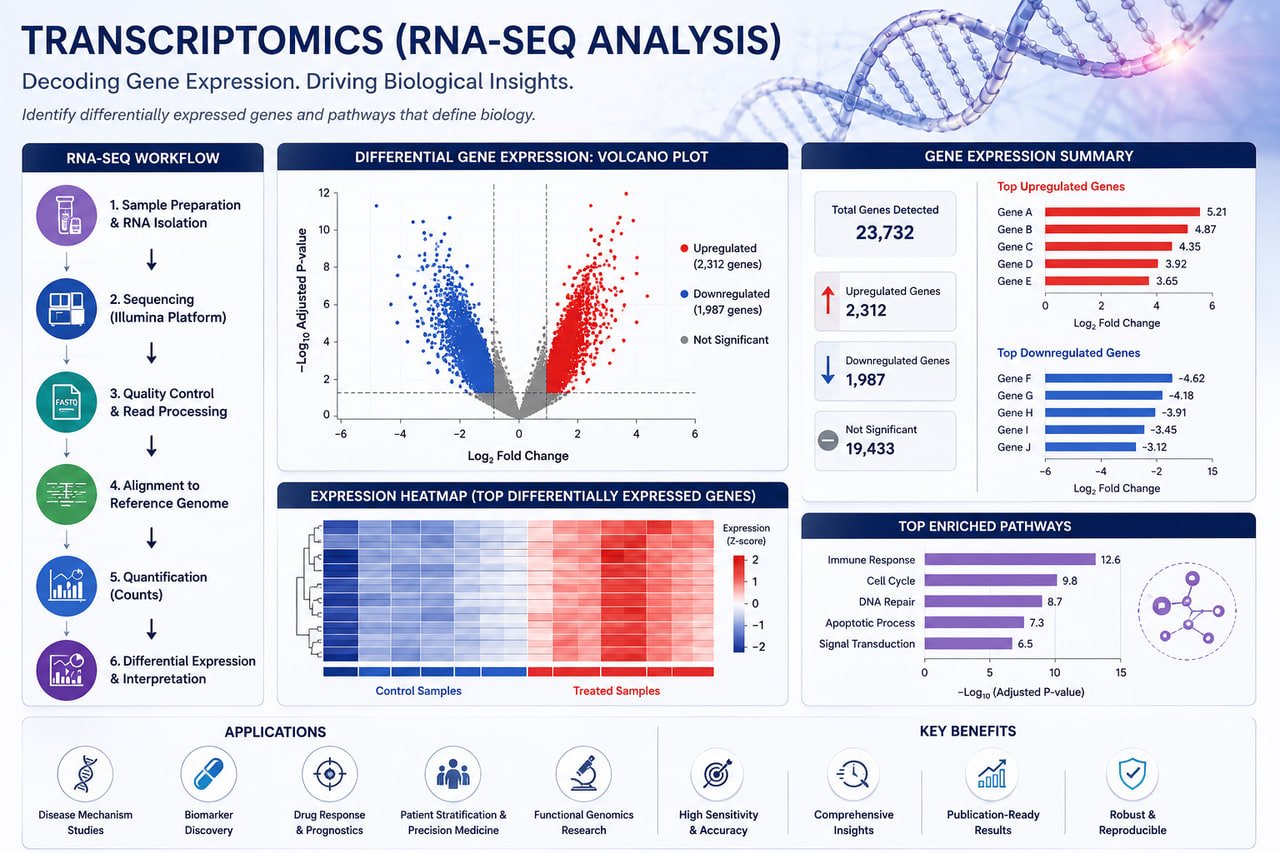
Transcriptomics (RNA-Seq)

RASA Life Science Informatics provides advanced RNA-Seq data analysis services to support pharmaceutical companies, biotechnology organizations, research institutes, CROs, hospitals, and academic laboratories. Our transcriptomics workflows enable comprehensive gene expression profiling, differential expression analysis, pathway discovery, biomarker identification, and disease mechanism investigation across diverse biological systems.

Using scalable, cloud-ready bioinformatics pipelines, we transform raw sequencing data into biologically meaningful insights that support drug discovery, precision medicine, cancer research, immunology, neuroscience, infectious diseases, and translational research.

Our RNA-Seq analysis services support Illumina, Oxford Nanopore, and PacBio sequencing platforms and deliver publication-ready reports, interactive visualizations, and actionable biological interpretation.

Service Offerings

What We Offer

Gene Expression Profiling

  • โœ“Transcriptome-wide expression quantification
  • โœ“Gene expression comparison across conditions
  • โœ“Expression signature identification
  • โœ“Molecular phenotype characterization

Differential Expression Analysis

  • โœ“Differentially expressed gene (DEG) identification
  • โœ“Statistical significance testing
  • โœ“Condition-specific expression analysis
  • โœ“Treatment response assessment

Functional & Pathway Analysis

  • โœ“Gene Ontology (GO) enrichment
  • โœ“KEGG pathway analysis
  • โœ“Reactome pathway enrichment
  • โœ“Biological process interpretation

Biomarker Discovery

  • โœ“Disease-associated biomarker identification
  • โœ“Therapeutic target discovery
  • โœ“Prognostic biomarker analysis
  • โœ“Predictive biomarker development

Network & Systems Biology

  • โœ“Gene co-expression analysis
  • โœ“Regulatory network analysis
  • โœ“Pathway interaction mapping
  • โœ“Functional module discovery
Capabilities

Key Features

โœ“Bulk RNA-Seq Analysis Expertise
โœ“Differential Gene Expression Analysis
โœ“Pathway & Functional Enrichment
โœ“Biomarker Discovery Workflows
โœ“AI-Assisted Transcriptomics Analytics
โœ“Cloud-Ready Reproducible Pipelines
โœ“Publication-Ready Scientific Reports
Applications

Applications

Cancer Transcriptomics

Tumor profiling, biomarker discovery, and therapeutic target identification.

Drug Discovery Research

Mechanism-of-action studies and target validation.

Immunology Research

Immune response and pathway analysis.

Neurogenomics

Gene expression profiling in neurological disorders.

Infectious Diseases

Host response and pathogen-associated transcriptomics.

Precision Medicine

Patient stratification and molecular profiling.

Technology

Technologies & Platforms

RNA-Seq Analysis Tools

STAR
HISAT2
Salmon
HTSeq

Differential Expression Analysis

DESeq2
edgeR
Limma

Functional Analysis

Gene Ontology (GO)
KEGG
Reactome
GSEA

Infrastructure

Nextflow
Snakemake
Docker
AWS
Google Cloud
HPC Clusters
Deliverables

Deliverables

โœ“Quality Control Reports
โœ“Differential Expression Reports
โœ“Annotated DEG Tables
โœ“Volcano Plots
โœ“Heatmaps
โœ“Pathway Enrichment Analysis
โœ“Gene Expression Visualizations
โœ“Publication-Ready Figures
โœ“Comprehensive Scientific Reports
Why RASA

Why Choose RASA?

AI-Assisted Bioinformatics

Machine learning-enabled workflows for biomarker discovery, variant prioritization, and predictive genomics.

Multi-Platform Expertise

Support for Illumina, Oxford Nanopore, PacBio HiFi, and 10x Genomics platforms.

End-to-End Analysis

From raw sequencing data to biological interpretation and publication-ready reports.

Cloud-Ready Infrastructure

Deployable on AWS, Google Cloud, HPC clusters, and secure on-premise environments.

Reproducible Workflows

Built using Nextflow, Snakemake, Docker, and Singularity for enterprise-grade bioinformatics operations.

Service FAQ

Frequently Asked Questions

RNA Sequencing (RNA-Seq) is a high-throughput transcriptomics technology used to measure gene expression across biological samples. RNA-Seq enables researchers to identify differentially expressed genes, discover disease-associated molecular signatures, investigate biological pathways, detect alternative splicing events, and uncover potential therapeutic targets. RNA-Seq has become one of the most widely used genomic technologies in cancer research, immunology, neuroscience, infectious diseases, drug discovery, and precision medicine.

RASA provides comprehensive RNA-Seq bioinformatics services including:
Bulk RNA-Seq Analysis
Differential Gene Expression Analysis
Alternative Splicing Analysis
Fusion Gene Detection
Transcript Quantification
Pathway Enrichment Analysis
Gene Set Enrichment Analysis (GSEA)
Co-Expression Network Analysis
Biomarker Discovery
Multi-Cohort Transcriptomics Studies
Clinical Transcriptomics Analytics
Our workflows support pharmaceutical companies, biotechnology organizations, hospitals, CROs, and academic researchers.

A standard RNA-Seq workflow typically includes:
Raw Data Quality Control
Adapter Trimming & Filtering
Read Alignment
Transcript Quantification
Normalization
Differential Expression Analysis
Functional Enrichment Analysis
Pathway Analysis
Biomarker Discovery
Statistical Validation
Biological Interpretation
Scientific Reporting
Each project is customized according to experimental design and research objectives.

Our transcriptomics workflows support data generated from:
Illumina Sequencing Platforms
Oxford Nanopore Technologies (ONT)
PacBio Iso-Seq
Hybrid Transcriptomics Workflows
We can analyze both short-read and long-read transcriptomics datasets.

Yes. RNA-Seq is one of the most powerful technologies for biomarker discovery. By identifying differentially expressed genes and disease-associated expression signatures, researchers can discover:
Diagnostic Biomarkers
Prognostic Biomarkers
Predictive Biomarkers
Therapeutic Response Markers
Drug Resistance Markers
RNA-Seq biomarker discovery is widely used in oncology, immunology, rare diseases, and precision medicine programs.

Differential Gene Expression (DGE) analysis compares gene expression levels between experimental groups such as disease versus healthy samples, treated versus untreated samples, or responders versus non-responders. This analysis identifies genes that are significantly upregulated or downregulated and helps uncover disease mechanisms, biological pathways, and therapeutic targets.

Gene Set Enrichment Analysis (GSEA) is a computational approach used to determine whether predefined groups of genes show statistically significant differences between biological conditions. GSEA helps researchers identify activated or suppressed biological pathways and provides deeper biological interpretation beyond individual gene-level analysis.

Pathway enrichment analysis identifies biological pathways that are significantly associated with differentially expressed genes. Common databases used include Gene Ontology (GO), KEGG, Reactome, and MSigDB. This analysis helps researchers understand molecular mechanisms underlying disease progression and treatment response.

Yes. RNA-Seq is widely used in drug discovery and translational research to identify potential therapeutic targets. By analyzing disease-specific gene expression patterns and pathway alterations, researchers can prioritize genes and molecular pathways for further experimental validation and therapeutic development.

We commonly accept:
FASTQ Files
BAM Files
CRAM Files
Count Matrices
Expression Tables
Metadata Files
If your data is already partially processed, our team can integrate it into customized analysis workflows.

Depending on project requirements, our pipelines utilize industry-standard tools including:
Alignment & Quantification
STAR
HISAT2
Salmon
Kallisto
HTSeq
Statistical Analysis
DESeq2
edgeR
limma
Functional Analysis
GSEA
ClusterProfiler
ReactomePA
Gene Ontology (GO)
KEGG
Workflow Infrastructure
Nextflow
Snakemake
Docker
AWS
Google Cloud

Typical RNA-Seq deliverables include:
Quality Control Reports
Differential Expression Reports
Annotated DEG Tables
Volcano Plots
Heatmaps
PCA Analysis
Pathway Enrichment Reports
GSEA Results
Biomarker Discovery Reports
Publication-Ready Figures
Comprehensive Scientific Reports
Deliverables can be customized according to project requirements.

For robust statistical analysis, a minimum of three biological replicates per experimental condition is generally recommended. However, the optimal number of replicates depends on study objectives, sample variability, sequencing depth, and available budget.

Yes. RNA-Seq data can be integrated with:
Whole Genome Sequencing (WGS)
Whole Exome Sequencing (WES)
Single-Cell Omics
Spatial Transcriptomics
Epigenomics
Proteomics
Metabolomics
Multi-omics integration provides a more comprehensive understanding of biological systems and disease mechanisms.

RASA Life Science Informatics combines expertise in transcriptomics, bioinformatics, computational biology, and AI-assisted analytics to deliver accurate, scalable, and reproducible RNA-Seq solutions. Our workflows are cloud-ready, publication-focused, and customized to support pharmaceutical research, biotechnology innovation, clinical genomics, and academic discovery programs.
๐Ÿ“ง info@rasalifesciences.com
๐ŸŒ www.rasalifesciences.com

Ready to partner with a trusted bioinformatics company in India?

Get in touch with our team in Pune, India to discuss sample sizes, platform details, and custom bioinformatics pipeline configurations for your research program.

Start a Project