
In-Silico Drug Discovery

Protein Structure Modeling

AI-powered protein structure prediction, structural bioinformatics, and structure-based drug-discovery support.
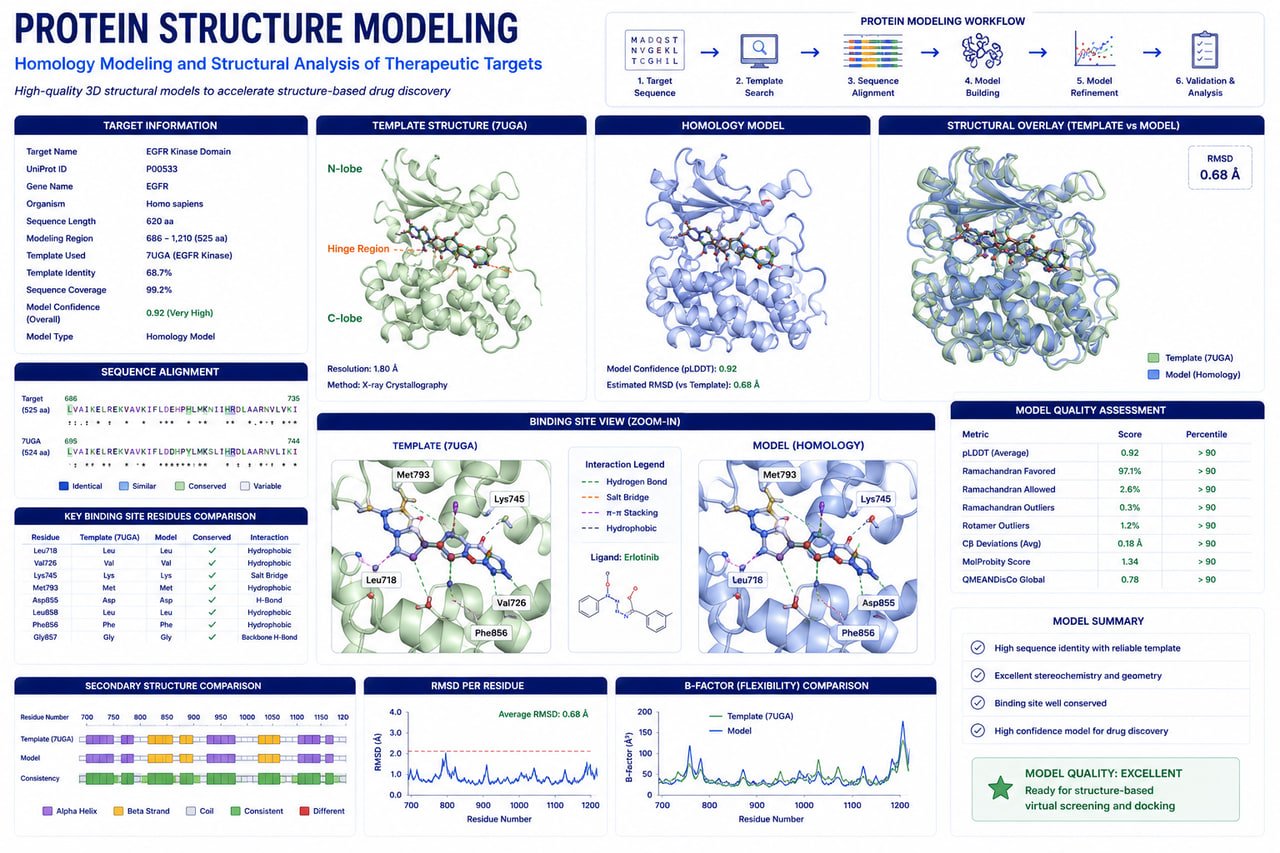
Protein Structure Modeling

RASA Life Science Informatics delivers advanced Protein Structure Modeling that combines artificial intelligence, homology modeling, and structural bioinformatics to generate accurate three-dimensional protein structures for therapeutic target characterization and downstream drug discovery.

Using industry-leading platforms such as AlphaFold, I-TASSER, SWISS-MODEL, and Protein Data Bank (PDB) resources, we predict, refine, validate, and analyze structures to deliver biologically meaningful insight into protein function, molecular interactions, and druggability.

Our services support pharmaceutical companies, biotechnology organizations, CROs, and academic researchers across oncology, neuroscience, infectious diseases, rare diseases, and precision medicine.

Workflow

How We Model a Structure

1Target sequence & QC
2Template search
3Model building
4Refinement
5Validation
6Docking-ready delivery
Service Offerings

What We Offer

From sequence to validated, docking-ready structures — the complete structural modeling stack.

Protein Structure Prediction

Accurate 3D models built from sequence using AI and template-based methods.

  • AlphaFold-based prediction
  • Homology modeling
  • Ab initio prediction
  • Comparative modeling

Structure Refinement & Validation

Optimized, validated models ready for rigorous downstream science.

  • Model optimization
  • Structural quality assessment
  • Ramachandran analysis
  • Validation & benchmarking

Binding Pocket & Active Site Analysis

Locate and characterize druggable cavities across the surface.

  • Binding-site identification
  • Active-site characterization
  • Pocket volume analysis
  • Druggability assessment

Functional Structural Annotation

Connect structure to biological function and disease impact.

  • Domain identification
  • Conserved-residue mapping
  • Mutation impact analysis
  • Structure–function interpretation

Structure Prep for Drug Discovery

Production-ready structures for docking, screening and MD.

  • Molecular docking prep
  • Virtual screening support
  • MD simulation prep
  • Structure-based design
Capabilities

Key Features

AI-Powered Protein Structure Prediction
Advanced Structural Bioinformatics
Binding Pocket & Active Site Analysis
Structure-Based Drug Discovery Support
Cloud-Ready Reproducible Workflows
Publication-Ready Reports & Visualizations
Sectors

Applications

Structure-Based Drug DesignTarget ValidationMolecular Docking StudiesVirtual Screening CampaignsProtein EngineeringMutation AnalysisFunctional GenomicsPrecision Medicine Research
Technology

Technologies & Platforms

Structure Prediction

AlphaFold
ColabFold
I-TASSER
SWISS-MODEL
MODELLER

Structural Analysis

PyMOL
ChimeraX
PDB
ProSA
PROCHECK

Infrastructure

Docker
Nextflow
AWS
Google Cloud
HPC Clusters
Why RASA

Why Choose RASA?

AI-Assisted Bioinformatics

Machine learning-enabled workflows for biomarker discovery, variant prioritization, and predictive genomics.

Multi-Platform Expertise

Support for Illumina, Oxford Nanopore, PacBio HiFi, and 10x Genomics platforms.

End-to-End Analysis

From raw sequencing data to biological interpretation and publication-ready reports.

Cloud-Ready Infrastructure

Deployable on AWS, Google Cloud, HPC clusters, and secure on-premise environments.

Reproducible Workflows

Built using Nextflow, Snakemake, Docker, and Singularity for enterprise-grade bioinformatics operations.

Service FAQ

Frequently Asked Questions

Protein Structure Modeling is a computational approach used to predict the three-dimensional (3D) structure of proteins from their amino acid sequences. Since protein structure directly influences biological function, accurate structural models are essential for understanding molecular mechanisms, identifying drug targets, designing therapeutics, and supporting structure-based drug discovery.
Protein structure prediction has become a critical component of modern computational biology, structural bioinformatics, and AI-driven drug discovery.

RASA Life Science Informatics offers comprehensive protein structure modeling services including:
AlphaFold Structure Prediction
Homology Modeling
Comparative Modeling
Ab Initio Structure Prediction
Structure Refinement
Structural Validation
Binding Pocket Identification
Active Site Prediction
Protein Function Annotation
Structural Bioinformatics Analysis
Protein–Ligand Interaction Preparation
Druggability Assessment
Our services support pharmaceutical companies, biotechnology organizations, CROs, and academic researchers.

Yes. We routinely predict protein structures that lack experimentally determined crystal or cryo-EM structures using advanced AI-powered and homology-based modeling approaches.
By leveraging technologies such as AlphaFold and comparative modeling, we can generate highly accurate structural models for proteins that are not available in public structural databases.

AlphaFold is an artificial intelligence system developed for predicting highly accurate protein structures directly from amino acid sequences. AlphaFold has transformed structural biology by significantly improving prediction accuracy for proteins lacking experimentally determined structures.
AlphaFold predictions are widely used for:
Drug Discovery
Target Identification
Structural Biology Research
Functional Annotation
Protein Engineering
Molecular Docking Studies

Homology Modeling predicts a protein structure using experimentally characterized proteins with similar sequences as templates. Since protein structure is often conserved across evolution, homologous proteins can provide highly reliable structural frameworks for modeling unknown proteins.
Homology modeling remains one of the most widely used approaches in structural bioinformatics.

AlphaFold uses deep learning and artificial intelligence to predict protein structures directly from sequence information, while Homology Modeling relies on experimentally determined template structures from related proteins.
In many projects, both approaches are used together to maximize model accuracy and confidence.

Our workflows support modeling of:
Enzymes
Receptors
GPCRs
Kinases
Antibodies
Viral Proteins
Bacterial Proteins
Membrane Proteins
Multi-Domain Proteins
Protein Complexes
Models can be generated for both well-characterized and novel protein sequences.

Structure Refinement improves the quality and accuracy of predicted protein models by optimizing atomic coordinates, correcting steric clashes, improving side-chain conformations, and enhancing structural stability.
Refinement helps generate models suitable for downstream applications such as molecular docking, molecular dynamics simulations, and drug discovery.

Structural Validation assesses the quality and reliability of predicted protein structures using multiple validation metrics and statistical analyses.
Validation typically includes:
Ramachandran Plot Analysis
Clash Score Assessment
Geometry Evaluation
Secondary Structure Analysis
Model Quality Scoring
This process ensures the structural model is suitable for scientific interpretation and downstream computational studies.

Binding Pocket Identification is the process of locating potential ligand-binding sites on a protein surface. These pockets often represent active sites, allosteric regions, or druggable cavities that can be targeted by therapeutic molecules.
Binding pocket analysis is a critical step in structure-based drug design and virtual screening workflows.

Druggability Assessment evaluates whether a protein target contains binding sites capable of interacting effectively with drug-like molecules.
Factors commonly evaluated include:
Pocket Size
Pocket Depth
Hydrophobicity
Accessibility
Ligandability
Structural Flexibility
This analysis helps prioritize targets for drug discovery programs.

Yes. Predicted protein structures are commonly used in:
Molecular Docking
Virtual Screening
Structure-Based Drug Design (SBDD)
Lead Optimization
Drug Repurposing Studies
Molecular Dynamics Simulations
These applications help accelerate therapeutic discovery when experimental structures are unavailable.

Our workflows integrate data from leading structural biology resources including:
Protein Data Bank (PDB)
AlphaFold Protein Structure Database
UniProt
InterPro
Pfam
SCOP
CATH
These databases support structure prediction, annotation, and validation workflows.

Our structural bioinformatics workflows utilize:
Structure Prediction
AlphaFold
ColabFold
I-TASSER
SWISS-MODEL
MODELLER
Structural Analysis
PyMOL
UCSF Chimera
ChimeraX
VMD
Binding Pocket Analysis
CASTp
Fpocket
DoGSiteScorer
P2Rank
Workflow Infrastructure
Nextflow
Snakemake
Docker
AWS
Google Cloud

Typical deliverables include:
Predicted 3D Protein Structures
Refined Structural Models
Structural Validation Reports
Ramachandran Plot Analysis
Binding Pocket Identification Reports
Active Site Maps
Druggability Assessment Reports
Structural Annotation Reports
Publication-Ready Figures
Scientific Interpretation Reports
Deliverables can be customized according to project requirements.

Protein structure modeling supports research across numerous therapeutic areas, including:
Oncology
Infectious Diseases
Neuroscience
Autoimmune Disorders
Rare Diseases
Antimicrobial Drug Discovery
Precision Medicine
Vaccine Development
Structural modeling helps accelerate target characterization and therapeutic development across diverse disease areas.

RASA combines expertise in structural biology, bioinformatics, AI-driven protein prediction, and computational drug discovery to deliver accurate and reproducible protein structure modeling solutions. Our integrated workflows, advanced analytical capabilities, cloud-ready infrastructure, and publication-ready reporting help researchers transform protein sequence data into actionable structural insights.
📧 info@rasalifesciences.com
🌐 www.rasalifesciences.com

Ready to partner with a trusted bioinformatics company in India?

Get in touch with our team in Pune, India to discuss sample sizes, platform details, and custom bioinformatics pipeline configurations for your research program.

Start a Project