
Computational Genomics & NGS

Metagenomics & Microbiome

AI-Powered Microbiome, Metagenomics & Microbial Community Analysis for Human Health, Agriculture & Environmental Research
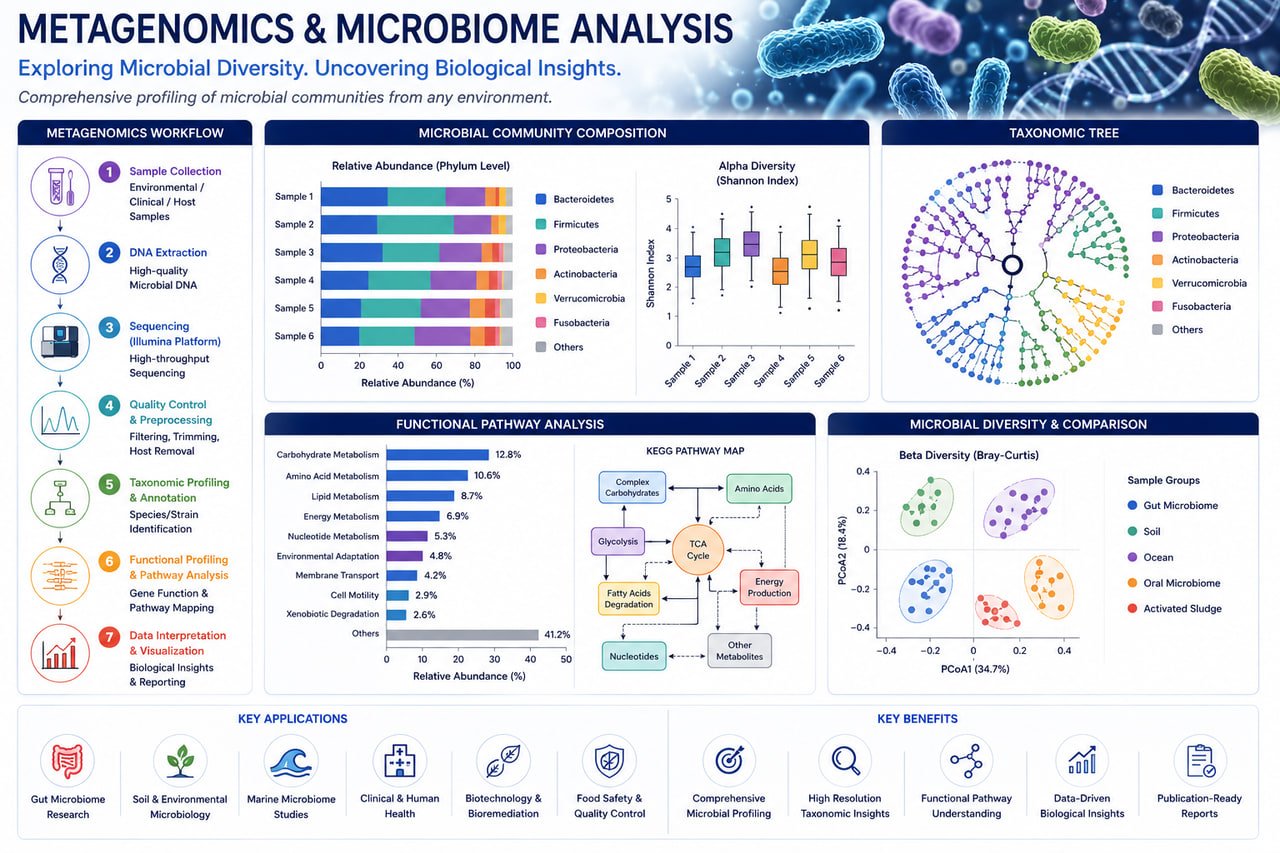
Metagenomics & Microbiome

RASA Life Science Informatics provides advanced Metagenomics & Microbiome analysis services that enable researchers to characterize microbial communities, understand host–microbe interactions, identify functional pathways, and discover microbiome-based biomarkers across diverse biological and environmental systems.

Our bioinformatics workflows support shotgun metagenomics, 16S rRNA sequencing, whole-metagenome sequencing (WMS), microbial diversity studies, functional profiling, resistome analysis, and microbiome-driven biomarker discovery. We help pharmaceutical companies, biotechnology organizations, hospitals, research institutes, agricultural researchers, and environmental scientists transform complex sequencing datasets into actionable biological insights.

Using scalable, cloud-ready, and reproducible pipelines, we support microbiome research across human health, oncology, gastrointestinal disorders, infectious diseases, agriculture, veterinary sciences, food safety, and environmental monitoring.

Service Offerings

Metagenomics & Microbiome Services

16S rRNA Microbiome Analysis

Characterize microbial composition and diversity across biological samples.

  • Taxonomic classification
  • Alpha diversity analysis
  • Beta diversity analysis
  • Differential abundance analysis
  • Microbial community profiling
  • Biomarker identification

Shotgun Metagenomics Analysis

Comprehensive characterization of microbial communities at species and functional levels.

  • Taxonomic profiling
  • Functional pathway analysis
  • Gene abundance analysis
  • Microbial genome reconstruction
  • Species-level classification
  • Comparative metagenomics

Microbiome Functional Profiling

Investigate the biological functions encoded within microbial communities.

  • Metabolic pathway analysis
  • Functional annotation
  • Enzyme profiling
  • KEGG pathway analysis
  • Microbial gene function prediction
  • Community functional comparison

Host–Microbiome Interaction Analysis

Understand how microbial communities influence host physiology and disease.

  • Microbiome–host association studies
  • Disease-specific microbiome analysis
  • Multi-omics microbiome integration
  • Clinical microbiome profiling
  • Therapeutic response association studies

Resistome & Antimicrobial Resistance Analysis

Identify antimicrobial resistance genes and resistance mechanisms.

  • AMR gene detection
  • Resistome profiling
  • Mobile genetic element analysis
  • Resistance pathway characterization
  • Public health surveillance support
Capabilities

Key Features

16S rRNA & Shotgun Metagenomics Expertise
Microbiome Diversity & Functional Analysis
Host–Microbiome Interaction Studies
Antimicrobial Resistance Profiling
AI-Assisted Biomarker Discovery
Multi-Omics Microbiome Integration
Cloud-Ready Reproducible Pipelines
Publication-Ready Reports & Visualizations
Deliverables

Deliverables

Microbial Community Analysis

Taxonomic Composition Reports
Relative Abundance Profiles
Alpha & Beta Diversity Analysis
Differential Abundance Reports
Core Microbiome Identification

Functional Analysis Outputs

KEGG Pathway Analysis
Functional Annotation Reports
Metabolic Pathway Profiling
Resistome Analysis Reports
Microbial Interaction Networks

Visualization & Reporting

Taxonomic Bar Charts
Krona Interactive Plots
PCA & PCoA Visualizations
Heatmaps & Clustering Analysis
Publication-Ready Figures
Comprehensive Scientific Reports
Applications

Applications

Human Microbiome Research

Gut, oral, skin, respiratory, and disease-associated microbiome studies.

Cancer Microbiome Studies

Microbiome-associated cancer biomarkers and therapeutic response analysis.

Infectious Disease Research

Microbial community profiling and pathogen surveillance.

Precision Medicine

Microbiome-driven patient stratification and biomarker discovery.

Agriculture & Veterinary Sciences

Plant microbiome, soil microbiome, livestock health, and agricultural biotechnology research.

Environmental Microbiology

Environmental monitoring, biodiversity assessment, and ecosystem studies.

Technology

Technologies & Platforms

Microbiome Analysis Tools

QIIME 2
Mothur
DADA2
USEARCH
VSEARCH

Shotgun Metagenomics Tools

Kraken2
Bracken
MetaPhlAn
HUMAnN
MEGAHIT
MetaSPAdes

Functional Analysis

KEGG
EggNOG
UniProt
PICRUSt2

Infrastructure

Nextflow
Snakemake
Docker
AWS
Google Cloud
HPC Clusters
Highlights

Representative Analysis Outputs

Microbial Diversity Profiling

Characterization of microbial richness, diversity, and community structure.

Functional Microbiome Analysis

Identification of metabolic pathways and microbial functions.

Host–Microbiome Associations

Discovery of microbiome signatures linked to disease and therapeutic response.

Resistome Analysis

Detection and characterization of antimicrobial resistance genes.

Microbiome Biomarker Discovery

Identification of predictive and diagnostic microbial biomarkers.

Why RASA

Why Choose RASA?

AI-Assisted Bioinformatics

Machine learning-enabled workflows for biomarker discovery, variant prioritization, and predictive genomics.

Multi-Platform Expertise

Support for Illumina, Oxford Nanopore, PacBio HiFi, and 10x Genomics platforms.

End-to-End Analysis

From raw sequencing data to biological interpretation and publication-ready reports.

Cloud-Ready Infrastructure

Deployable on AWS, Google Cloud, HPC clusters, and secure on-premise environments.

Reproducible Workflows

Built using Nextflow, Snakemake, Docker, and Singularity for enterprise-grade bioinformatics operations.

Service FAQ

Frequently Asked Questions

Metagenomics is the study of genetic material recovered directly from environmental, clinical, or host-associated samples without the need for culturing microorganisms. Unlike traditional microbiology, which relies on laboratory cultivation, metagenomics enables researchers to identify and characterize entire microbial communities, including bacteria, viruses, fungi, archaea, and other microorganisms that may be difficult or impossible to culture.

RASA Life Science Informatics offers comprehensive microbiome and metagenomics analysis services, including:
16S rRNA Sequencing Analysis
Shotgun Metagenomics Analysis
Taxonomic Profiling
Functional Profiling
Metagenome Assembly
Resistome Analysis
Virulome Analysis
Microbial Diversity Analysis
Host–Microbiome Interaction Analysis
Comparative Microbiome Studies
Biomarker Discovery
Multi-Omics Microbiome Integration
Our services support academic, clinical, pharmaceutical, agricultural, and environmental research projects.

16S rRNA sequencing is a widely used microbiome profiling technique that targets the 16S ribosomal RNA gene found in bacteria and archaea. This approach enables researchers to identify microbial taxa, estimate relative abundance, evaluate community diversity, and compare microbiome composition across samples. It is commonly used in gut microbiome research, environmental microbiology, and clinical microbiome studies.

Shotgun metagenomic sequencing analyzes all genetic material present within a sample rather than targeting a specific marker gene. This approach provides higher taxonomic resolution and enables the identification of bacteria, viruses, fungi, archaea, antimicrobial resistance genes, virulence factors, and metabolic pathways.
Shotgun metagenomics is commonly used for microbiome characterization, pathogen discovery, functional profiling, and systems biology studies.

A standard microbiome analysis workflow may include:
Quality Control & Filtering
Taxonomic Classification
Alpha Diversity Analysis
Beta Diversity Analysis
Differential Abundance Analysis
Functional Profiling
Pathway Analysis
Resistome Analysis
Virulome Analysis
Host–Microbiome Interaction Analysis
Biomarker Discovery
Scientific Interpretation & Reporting
Workflows are customized according to study objectives and sequencing technologies.

Microbial diversity analysis evaluates the composition and complexity of microbial communities.
Alpha Diversity
Measures diversity within a single sample using metrics such as:
Shannon Diversity Index
Simpson Index
Chao1 Richness
Beta Diversity
Measures differences between microbial communities across samples using methods such as:
Bray-Curtis Dissimilarity
UniFrac Distance
Principal Coordinate Analysis (PCoA)
These analyses help researchers understand microbial ecosystem structure and disease-associated changes.

Functional profiling predicts the biological functions and metabolic capabilities of microbial communities. This analysis identifies genes and pathways involved in:
Metabolism
Nutrient Utilization
Antibiotic Resistance
Virulence
Host Interactions
Environmental Adaptation
Functional profiling provides deeper biological insights beyond taxonomic composition.

Resistome analysis identifies antimicrobial resistance (AMR) genes present within microbial communities. This analysis is critical for understanding antibiotic resistance patterns in clinical, environmental, agricultural, and public health research.
Applications include:
Hospital Surveillance
Pathogen Monitoring
Environmental Resistance Studies
One Health Research

Virulome analysis identifies microbial genes associated with pathogenicity and virulence. This approach helps researchers investigate infection mechanisms, pathogen evolution, host-pathogen interactions, and disease progression.
Virulome studies are widely used in infectious disease research and clinical microbiology.

Host–Microbiome Interaction Analysis investigates the relationship between microbial communities and host biological systems. By integrating microbiome and host omics datasets, researchers can identify microbial signatures associated with immune responses, metabolism, disease progression, and therapeutic outcomes.
This approach is increasingly used in precision medicine and translational research.

Our workflows utilize industry-leading microbiome and metagenomics software, including:
Taxonomic Profiling
QIIME2
Kraken2
MetaPhlAn
Bracken
Functional Profiling
HUMAnN
EggNOG
PICRUSt2
Assembly & Annotation
MEGAHIT
SPAdes
Prokka
Statistical Analysis
R
Phyloseq
MicrobiomeAnalyst
Workflow Infrastructure
Nextflow
Snakemake
Docker
AWS
Google Cloud

We commonly support:
FASTQ Files
BAM Files
Taxonomic Tables
OTU Tables
ASV Tables
Metadata Files
Environmental Metadata
We can also accommodate platform-specific formats.

Our microbiome services support a wide range of research areas, including:
Human Health & Medicine
Gut Microbiome Research
Cancer Microbiome Studies
Autoimmune Disease Research
Metabolic Disease Research
Infectious Disease Research
Environmental Microbiology
Soil Microbiome Analysis
Marine Microbiology
Wastewater Monitoring
Environmental Biodiversity Studies
Agriculture & Veterinary Science
Plant Microbiome Research
Livestock Microbiome Studies
Crop Health Monitoring
Agricultural Sustainability Programs
Pharmaceutical & Biotechnology Research
Microbiome-Based Therapeutics
Probiotic Development
Drug–Microbiome Interaction Studies
Precision Medicine Programs

Typical project deliverables include:
Taxonomic Profiling Reports
Diversity Analysis Reports
Differential Abundance Analysis
Functional Profiling Results
Resistome Reports
Virulome Reports
Biomarker Discovery Reports
PCoA & Diversity Visualizations
Publication-Ready Figures
Comprehensive Scientific Reports
Deliverables can be customized according to project objectives.

RASA combines expertise in microbiology, genomics, bioinformatics, systems biology, and AI-driven analytics to deliver robust and reproducible microbiome solutions. Our scalable workflows, advanced analytical capabilities, publication-ready reporting, and experience across healthcare, agriculture, biotechnology, and environmental sciences help researchers unlock meaningful insights from microbial communities.
📧 info@rasalifesciences.com
🌐 www.rasalifesciences.com

Ready to partner with a trusted bioinformatics company in India?

Get in touch with our team in Pune, India to discuss sample sizes, platform details, and custom bioinformatics pipeline configurations for your research program.

Start a Project