
Computational Genomics & NGS

Single-Cell Omics

AI-Powered Single-Cell RNA Sequencing (scRNA-Seq), Single-Cell ATAC-Seq & Multiome Analysis Services
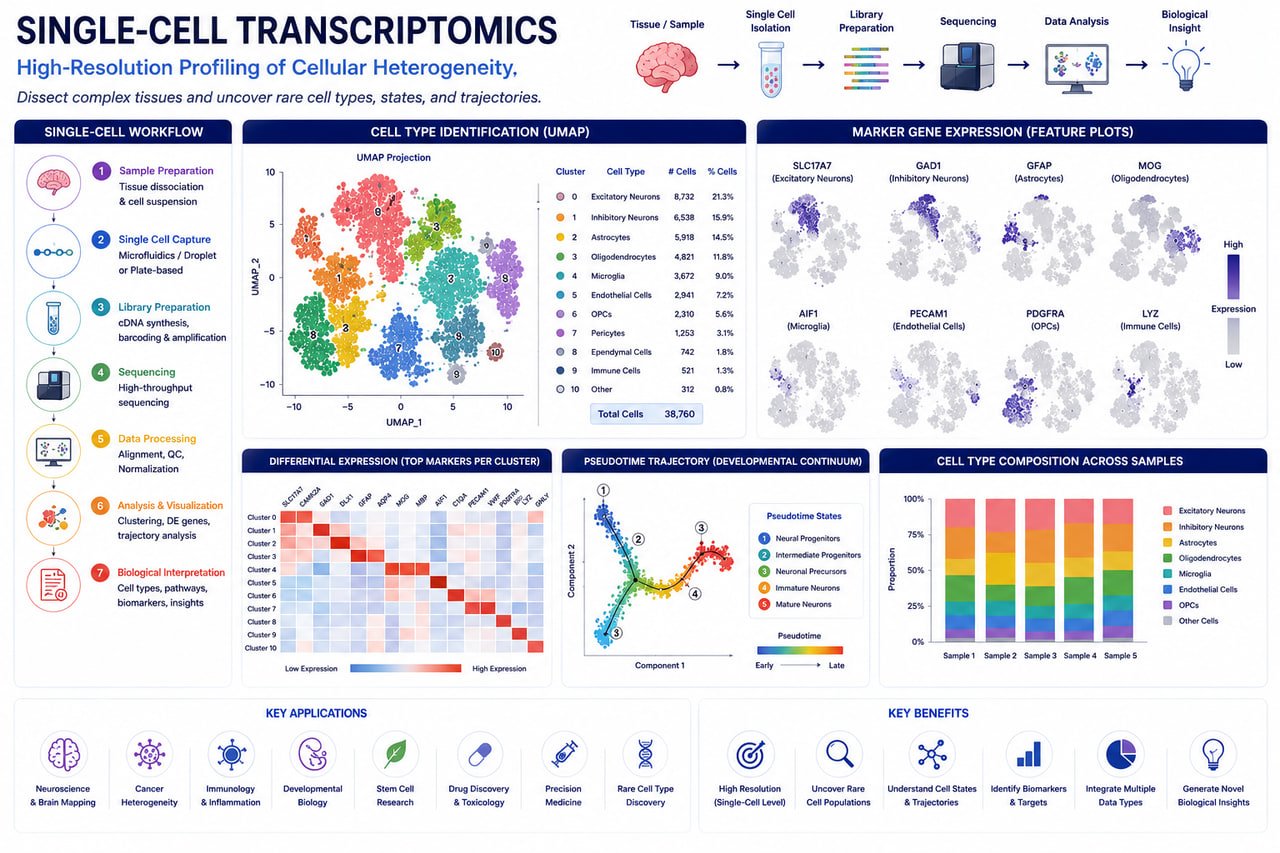
Single-Cell Omics

RASA Life Science Informatics provides advanced Single-Cell Omics analysis services that enable researchers to explore cellular heterogeneity, identify rare cell populations, characterize cellular states, and uncover complex biological mechanisms at single-cell resolution.

Our AI-powered bioinformatics workflows support Single-Cell RNA Sequencing (scRNA-seq), Single-Cell ATAC-seq (scATAC-seq), Multiome Analysis (RNA + ATAC), Cell–Cell Communication Analysis, Trajectory Inference, and Spatially Resolved Single-Cell Studies. We help pharmaceutical companies, biotechnology organizations, hospitals, research institutes, and academic laboratories transform large-scale single-cell datasets into biologically meaningful insights.

Using scalable and reproducible computational pipelines, we support projects across oncology, immunology, neuroscience, developmental biology, regenerative medicine, infectious diseases, rare diseases, and precision medicine research.

Service Offerings

Single-Cell Omics Services

Single-Cell RNA Sequencing (scRNA-seq)

High-resolution transcriptomic profiling of individual cells for understanding cellular diversity and gene expression dynamics.

  • Cell clustering and subpopulation identification
  • Cell-type annotation
  • Marker gene discovery
  • Differential expression analysis
  • Rare cell population detection
  • Batch correction and data integration

Single-Cell ATAC-Seq (scATAC-seq)

Analysis of chromatin accessibility at single-cell resolution to understand gene regulation and epigenetic mechanisms.

  • Peak calling and accessibility analysis
  • Regulatory element identification
  • Transcription factor activity analysis
  • Chromatin state characterization
  • Integration with scRNA-seq datasets

Multiome Analysis (RNA + ATAC)

Integrated transcriptomic and epigenomic analysis to connect gene expression with regulatory mechanisms.

  • Multi-modal data integration
  • Gene regulatory network construction
  • Cell-state characterization
  • Regulatory pathway discovery
  • Cross-platform data harmonization

Cell–Cell Communication Analysis

Identify signaling interactions between cell populations within tissues and disease microenvironments.

  • Ligand–receptor interaction analysis
  • Tumor microenvironment profiling
  • Immune cell communication mapping
  • Network visualization
  • Pathway-level interaction analysis

Trajectory & Pseudotime Analysis

Investigate cellular differentiation, lineage relationships, and dynamic biological processes.

  • Developmental trajectory analysis
  • Pseudotime inference
  • Cell fate prediction
  • RNA velocity analysis
  • Differentiation pathway modeling
Capabilities

Key Features

Single-Cell RNA-Seq Analysis
Single-Cell ATAC-Seq Analysis
Multiome Integration
AI-Assisted Cell Type Annotation
Cell–Cell Communication Analysis
Trajectory & Pseudotime Modeling
Cloud-Ready Reproducible Pipelines
Publication-Ready Visualizations
Deliverables

Deliverables

Single-Cell Analysis Outputs

UMAP Visualizations
t-SNE Projections
Cell Clustering Reports
Cell-Type Annotation Results
Marker Gene Analysis
Differential Expression Reports
Trajectory & Pseudotime Analysis
RNA Velocity Visualizations
Cell–Cell Communication Networks
Publication-Ready Figures
Applications

Applications

Cancer Research

Tumor heterogeneity analysis, tumor microenvironment profiling, and immuno-oncology studies.

Immunology

Immune cell characterization and immune response profiling.

Neuroscience

Neuronal diversity analysis and neurodevelopmental studies.

Developmental Biology

Cell differentiation and lineage tracing.

Stem Cell Research

Cell fate determination and regenerative medicine studies.

Precision Medicine

Patient-specific cellular profiling and therapeutic response prediction.

Infectious Disease Research

Host–pathogen interaction studies at single-cell resolution.

Technology

Technologies & Platforms

Single-Cell Analysis Platforms

10x Genomics Chromium
SMART-seq2
Drop-seq
CEL-Seq
Parse Biosciences

Bioinformatics Tools

Cell Ranger
Seurat
Scanpy
Harmony
SingleR
Monocle
Slingshot
scVelo
ArchR

Cell Communication Tools

CellChat
CellPhoneDB
NicheNet
LIANA

Infrastructure

Nextflow
Snakemake
Docker
AWS
Google Cloud
HPC Clusters
Highlights

Representative Analysis Outputs

Cellular Heterogeneity Analysis

Identification of known and novel cellular populations.

Cell-State Discovery

Detection of disease-associated cellular states and transitions.

Immune Profiling

Characterization of immune landscapes and response mechanisms.

Cell–Cell Interaction Networks

Understanding signaling pathways within complex tissues.

Multiomic Regulatory Analysis

Linking chromatin accessibility to gene expression.

Why RASA

Why Choose RASA?

AI-Assisted Bioinformatics

Machine learning-enabled workflows for biomarker discovery, variant prioritization, and predictive genomics.

Multi-Platform Expertise

Support for Illumina, Oxford Nanopore, PacBio HiFi, and 10x Genomics platforms.

End-to-End Analysis

From raw sequencing data to biological interpretation and publication-ready reports.

Cloud-Ready Infrastructure

Deployable on AWS, Google Cloud, HPC clusters, and secure on-premise environments.

Reproducible Workflows

Built using Nextflow, Snakemake, Docker, and Singularity for enterprise-grade bioinformatics operations.

Service FAQ

Frequently Asked Questions

Single-Cell Omics is a powerful genomics approach that enables researchers to study biological systems at the resolution of individual cells. Unlike traditional bulk sequencing methods, which measure average signals across thousands or millions of cells, single-cell technologies reveal cellular heterogeneity, identify rare cell populations, characterize cellular states, and uncover complex biological interactions. Single-cell omics has become a critical tool in cancer research, immunology, neuroscience, developmental biology, regenerative medicine, and precision medicine.

Single-Cell RNA Sequencing (scRNA-seq) is a transcriptomics technology that measures gene expression in individual cells. It enables researchers to identify distinct cell types, investigate cellular heterogeneity, discover rare cell populations, and study dynamic biological processes such as differentiation, disease progression, and immune responses. scRNA-seq is widely used in oncology, immunology, neuroscience, stem cell biology, and drug discovery research.

RASA Life Science Informatics provides comprehensive single-cell bioinformatics services including:
Single-Cell RNA Sequencing (scRNA-seq)
Single-Cell ATAC-Seq (scATAC-seq)
Multiome Analysis (RNA + ATAC)
Cell-Type Annotation
Cell Clustering
Trajectory & Pseudotime Analysis
RNA Velocity Analysis
Cell–Cell Communication Analysis
Spatial Single-Cell Integration
Multi-Omics Single-Cell Analysis
Biomarker Discovery
Disease Microenvironment Characterization

Our workflows support data generated from leading single-cell platforms, including:
10x Genomics Chromium
SMART-seq2
Parse Biosciences
Drop-seq
CEL-Seq
Seq-Well
BD Rhapsody
We also support integration with spatial transcriptomics and multiomic datasets.

Single-Cell ATAC-Seq is an epigenomics technology that measures chromatin accessibility at single-cell resolution. It enables researchers to identify regulatory elements, transcription factor activity, epigenetic states, and gene regulatory networks across different cell populations. scATAC-seq is commonly used alongside scRNA-seq to gain deeper insights into cellular regulation and disease biology.

Multiome analysis simultaneously measures gene expression and chromatin accessibility within the same cell. By integrating scRNA-seq and scATAC-seq data, researchers can better understand how regulatory mechanisms influence gene expression and cellular behavior. Multiome technologies provide a comprehensive view of cellular identity, function, and disease-associated changes.

A standard single-cell workflow may include:
Data Quality Control
Cell Filtering
Doublet Detection
Batch Correction
Dimensionality Reduction
Cell Clustering
Cell-Type Annotation
Differential Expression Analysis
Marker Gene Identification
Trajectory Analysis
RNA Velocity Analysis
Cell–Cell Communication Analysis
Functional Enrichment Analysis
Biological Interpretation
Workflows are customized based on project objectives and dataset complexity.

Cell clustering is the process of grouping cells with similar gene expression profiles into biologically meaningful populations. Clustering helps identify known cell types, discover novel cell populations, and characterize disease-associated cellular states. Popular visualization methods include UMAP and t-SNE projections.

Cell-type annotation assigns biological identities to cell clusters using known marker genes, reference datasets, and machine learning approaches. This process helps researchers determine which immune cells, stromal cells, tumor cells, neuronal cells, or other cellular populations are present within a sample.

Trajectory analysis reconstructs cellular developmental pathways and differentiation processes. Pseudotime analysis orders cells along a biological timeline based on gene expression changes, allowing researchers to study cell fate decisions, developmental transitions, and disease progression mechanisms.

RNA velocity predicts the future transcriptional state of individual cells by analyzing spliced and unspliced RNA molecules. This technique helps researchers understand cellular dynamics, developmental trajectories, and cell-state transitions in complex biological systems.

Cell–cell communication analysis identifies signaling interactions between different cell populations using ligand–receptor expression patterns. This approach helps researchers understand tissue organization, immune responses, tumor microenvironments, and cellular interactions driving disease progression.

Yes. We routinely integrate single-cell and spatial transcriptomics datasets to map cell populations back to their native tissue locations. This combined approach provides deeper insights into tissue architecture, cellular interactions, and disease-associated microenvironments.

Typical deliverables include:
UMAP Visualizations
t-SNE Projections
Cell Clustering Reports
Cell-Type Annotation Results
Marker Gene Analysis
Differential Expression Reports
Trajectory & Pseudotime Analysis
RNA Velocity Visualizations
Cell–Cell Communication Networks
Functional Enrichment Reports
Publication-Ready Figures
Comprehensive Scientific Reports
Deliverables can be customized according to project requirements.

Our pipelines utilize industry-leading tools including:
Single-Cell Analysis
Cell Ranger
Seurat
Scanpy
Harmony
SingleR
ArchR
Trajectory Analysis
Monocle
Slingshot
PAGA
RNA Velocity
scVelo
Velocyto
Cell Communication
CellChat
CellPhoneDB
NicheNet
LIANA
Workflow Infrastructure
Nextflow
Snakemake
Docker
AWS
Google Cloud

Single-cell technologies are widely used for:
Cancer Research
Immunology
Neuroscience
Developmental Biology
Stem Cell Research
Regenerative Medicine
Infectious Disease Research
Precision Medicine
Drug Discovery
Biomarker Discovery
These applications help researchers uncover cellular mechanisms that cannot be resolved using bulk sequencing approaches.

RASA combines expertise in genomics, bioinformatics, machine learning, and systems biology to deliver high-quality single-cell analysis solutions. Our scalable workflows, advanced analytical capabilities, publication-ready reporting, and experience across diverse biological applications help researchers maximize the value of their single-cell datasets.
📧 info@rasalifesciences.com
🌐 www.rasalifesciences.com

Ready to partner with a trusted bioinformatics company in India?

Get in touch with our team in Pune, India to discuss sample sizes, platform details, and custom bioinformatics pipeline configurations for your research program.

Start a Project