In-Silico Drug Discovery

Virtual Screening & Molecular Docking

Accelerate Drug Discovery with High-Throughput Virtual Screening and Structure-Based Molecular Docking
Virtual Screening & Molecular Docking

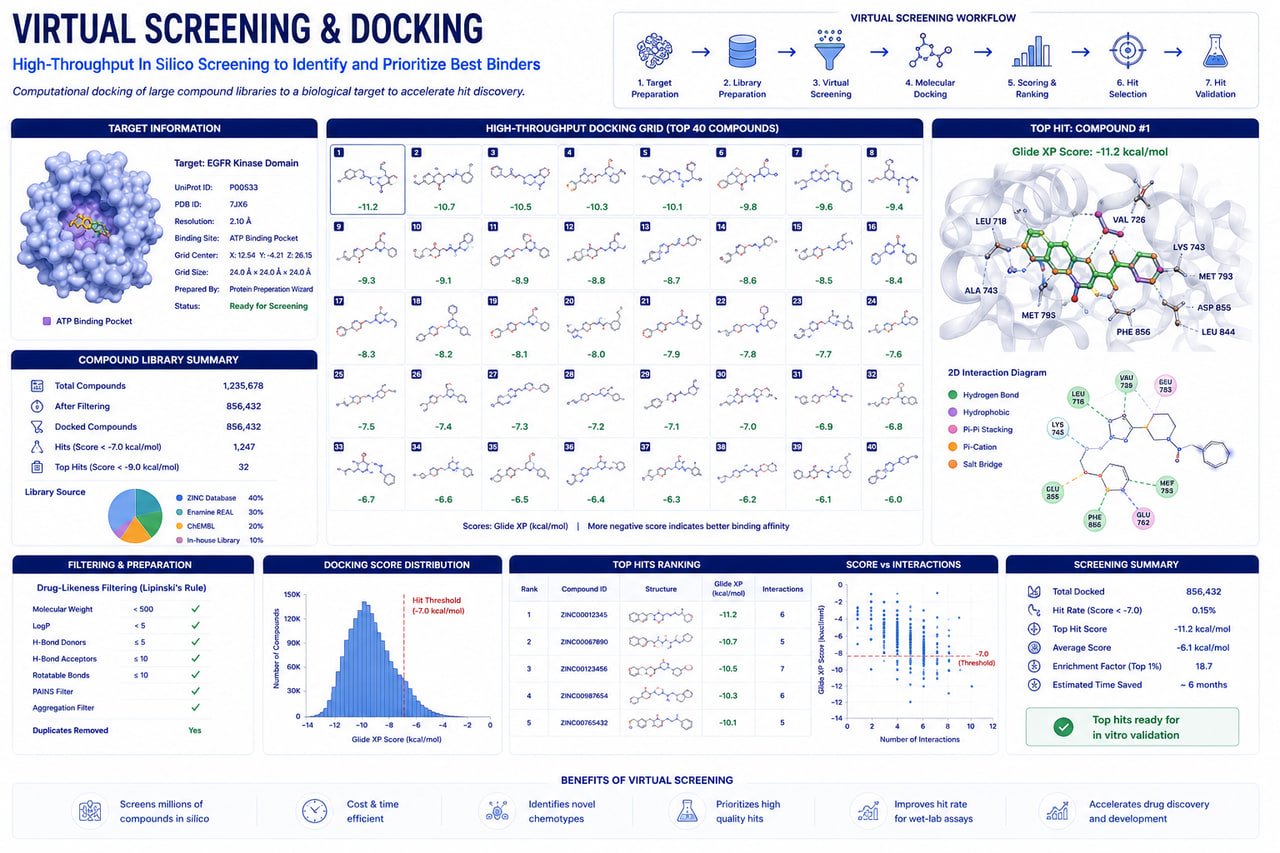
RASA Life Science Informatics provides advanced Virtual Screening & Molecular Docking services to support pharmaceutical companies, biotechnology organizations, CROs, and academic researchers in identifying promising drug candidates against validated therapeutic targets.

Our computational drug discovery platform combines structure-based virtual screening, molecular docking, pharmacophore modeling, ligand-based screening, and AI-assisted compound prioritization to rapidly evaluate large chemical libraries and identify high-confidence candidate molecules for downstream drug development.

By integrating structural bioinformatics, computational chemistry, and machine learning-driven scoring strategies, we enable efficient identification of compounds with favorable binding affinity, molecular interactions, and drug-like properties while significantly reducing experimental screening costs and timelines.

Service Offerings

What We Offer

Structure-Based Virtual Screening

  • High-throughput screening of large compound libraries
  • Protein-target focused screening workflows
  • Hit prioritization and ranking
  • Drug repurposing studies

Molecular Docking

  • Protein–ligand docking
  • Protein–peptide docking
  • Flexible ligand docking
  • Binding pose prediction
  • Binding affinity estimation

Ligand-Based Screening

  • Similarity-based screening
  • Pharmacophore modeling
  • Shape-based screening
  • Chemical space exploration

Compound Library Screening

  • ZINC database
  • ChEMBL
  • DrugBank
  • FDA-approved drug libraries
  • Natural product libraries
  • Custom client libraries

AI-Assisted Candidate Prioritization

  • Machine learning-based scoring
  • Toxicity prediction
  • Drug-likeness assessment
  • Compound ranking and clustering
Capabilities

Key Features

High-Throughput Screening Capability

Screen thousands to millions of compounds efficiently using scalable computational infrastructure.

Multiple Docking Engines

Support for multiple docking algorithms to improve prediction confidence and result validation.

Advanced Interaction Analysis

Comprehensive evaluation of hydrogen bonds, hydrophobic contacts, electrostatic interactions, and binding site occupancy.

Drug-Likeness & ADMET Filtering

Pre-screening and post-screening filters to improve lead quality and reduce downstream attrition.

Reproducible Workflows

Containerized pipelines using Docker, Nextflow, Snakemake, and cloud-ready infrastructure.

Deliverables

Deliverables

Clients receive:

Ranked compound libraries
Docking score summaries
Binding interaction analyses
2D interaction diagrams
3D protein–ligand visualizations
Drug-likeness assessment reports
ADMET prediction summaries
Publication-ready figures and reports
Applications

Applications

Novel Drug Discovery

Identification of new chemical entities against therapeutic targets.

Drug Repurposing

Screening of approved and investigational compounds for new indications.

Fragment-Based Drug Discovery

Identification and optimization of fragment hits.

Precision Medicine Research

Target-specific therapeutic candidate identification.

Multi-Target Drug Discovery

Evaluation of compounds against multiple disease-relevant targets.

Lead Generation Programs

Generation of high-confidence candidates for molecular dynamics simulation and lead optimization studies.

Technology

Technologies & Databases

Docking & Screening Platforms

AutoDock Vina
QuickVina2
Smina
CB-Dock2

Compound Databases

ZINC
ChEMBL
DrugBank
PubChem

ADMET & Drug-Likeness Tools

SwissADME
pkCSM
ADMETlab

Infrastructure

Docker
Nextflow
Snakemake
AWS
Google Cloud
HPC Clusters
Why RASA

Why Choose RASA?

AI-Assisted Bioinformatics

Machine learning-enabled workflows for biomarker discovery, variant prioritization, and predictive genomics.

Multi-Platform Expertise

Support for Illumina, Oxford Nanopore, PacBio HiFi, and 10x Genomics platforms.

End-to-End Analysis

From raw sequencing data to biological interpretation and publication-ready reports.

Cloud-Ready Infrastructure

Deployable on AWS, Google Cloud, HPC clusters, and secure on-premise environments.

Reproducible Workflows

Built using Nextflow, Snakemake, Docker, and Singularity for enterprise-grade bioinformatics operations.

Service FAQ

Frequently Asked Questions

Molecular Docking is a computational technique used to predict how a small molecule, peptide, or biomolecule binds to a target protein. Docking simulations estimate binding affinity, identify binding poses, and characterize molecular interactions between ligands and biological targets.
Molecular docking is widely used in structure-based drug design, virtual screening, lead optimization, drug repurposing, and therapeutic target validation.

RASA Life Science Informatics offers comprehensive molecular docking services, including:
Protein–Ligand Docking
Protein–Protein Docking
Peptide Docking
Antibody–Antigen Docking
Blind Docking
Covalent Docking
Fragment-Based Docking
Multi-Target Docking
Drug Repurposing Studies
Structure-Based Virtual Screening
Our workflows support pharmaceutical, biotechnology, CRO, and academic research projects.

Virtual Screening is a computational approach used to evaluate large chemical libraries against biological targets to identify potential hit compounds. By combining molecular docking, pharmacophore modeling, and AI-assisted filtering, virtual screening enables rapid prioritization of compounds before laboratory testing.
This significantly reduces experimental costs and accelerates early-stage drug discovery.

Our infrastructure supports virtual screening campaigns ranging from a few thousand compounds to millions of molecules.
We can screen compounds from:
ZINC Database
ChEMBL
DrugBank
Enamine Libraries
FDA-Approved Drug Libraries
Natural Product Libraries
Custom Compound Collections
Large-scale screening workflows can be deployed on cloud platforms and HPC clusters for maximum scalability.

Molecular Docking evaluates the interaction between a specific ligand and a target protein, while Virtual Screening applies docking and filtering techniques across thousands or millions of compounds to identify promising candidates.
In simple terms:
Docking = Detailed analysis of individual compounds
Virtual Screening = Large-scale compound discovery process
Most virtual screening workflows use molecular docking as a core component.

Our virtual screening and docking workflows support:
Enzymes
Receptors
GPCRs
Kinases
Ion Channels
Nuclear Receptors
Viral Proteins
Bacterial Targets
Protein Complexes
Antibodies
Peptides
Workflows can be customized for specific therapeutic areas and target classes.

Depending on project requirements, we utilize industry-standard docking tools including:
Molecular Docking
AutoDock Vina
Smina
QuickVina2
GNINA
CB-Dock2
AutoDock-GPU
Protein–Protein Docking
HADDOCK
ClusPro
HDOCK
Peptide Docking
HPEPDOCK
HADDOCK
GalaxyPepDock
These tools are selected based on target type, project objectives, and computational requirements.

Yes. Blind docking is used when the binding site is unknown or when researchers want to identify potential binding pockets across the entire protein surface.
Blind docking helps:
Discover novel binding sites
Investigate allosteric pockets
Explore ligand binding mechanisms
Support target characterization studies

Covalent docking predicts interactions between ligands and proteins that form covalent bonds. This approach is particularly important for designing irreversible inhibitors and targeted covalent therapeutics.
Applications include:
Oncology Drug Discovery
Antiviral Drug Development
Enzyme Inhibitor Design
Covalent Lead Optimization

Yes. Molecular docking is widely used in drug repurposing programs to identify new therapeutic applications for approved or investigational compounds.
Our repurposing workflows combine:
Target Prediction
Virtual Screening
Molecular Docking
Pathway Analysis
Network Pharmacology
This integrated strategy helps accelerate therapeutic discovery while reducing development costs.

A standard molecular docking workflow may include:
Protein Preparation
Ligand Preparation
Binding Site Identification
Docking Simulations
Binding Affinity Estimation
Interaction Analysis
Hit Ranking
ADMET Filtering
Scientific Interpretation
Reporting & Visualization
Workflows can be customized according to project goals.

Our docking reports typically include:
Hydrogen Bond Analysis
Hydrophobic Interactions
Salt Bridge Analysis
Pi–Pi Interactions
Pi–Cation Interactions
Binding Pocket Characterization
Interaction Fingerprints
These analyses help researchers understand ligand binding mechanisms and prioritize compounds.

Yes. Molecular Dynamics (MD) simulations are frequently used to validate docking results by evaluating the stability of protein–ligand interactions over time.
Combining docking and MD simulations provides:
Improved confidence in hit selection
Binding stability assessment
Conformational flexibility analysis
More realistic interaction modeling

Typical project deliverables include:
Docking Score Reports
Ranked Hit Lists
Binding Affinity Results
Protein–Ligand Interaction Maps
2D Interaction Diagrams
3D Binding Visualizations
Virtual Screening Reports
ADMET Assessment Reports
Hit Prioritization Reports
Publication-Ready Figures
Comprehensive Scientific Reports
Deliverables can be customized according to project objectives.

Our services support drug discovery programs across:
Oncology
Infectious Diseases
Neuroscience
Autoimmune Disorders
Cardiometabolic Diseases
Rare Diseases
Antimicrobial Research
Precision Medicine
Both small-molecule and biologics-based discovery programs can benefit from computational screening approaches.

RASA combines expertise in computational chemistry, structural biology, molecular modeling, cheminformatics, and AI-assisted drug discovery to deliver robust and reproducible virtual screening solutions. Our scalable cloud infrastructure, access to large compound libraries, publication-ready reporting, and integrated drug discovery workflows help researchers accelerate hit identification and lead optimization.
📧 info@rasalifesciences.com
🌐 www.rasalifesciences.com

Ready to partner with a trusted bioinformatics company in India?

Get in touch with our team in Pune, India to discuss sample sizes, platform details, and custom bioinformatics pipeline configurations for your research program.

Start a Project