
In-Silico Drug Discovery

Molecular Dynamics Simulation

Unlock Biomolecular Insights Through Advanced Molecular Dynamics Simulations
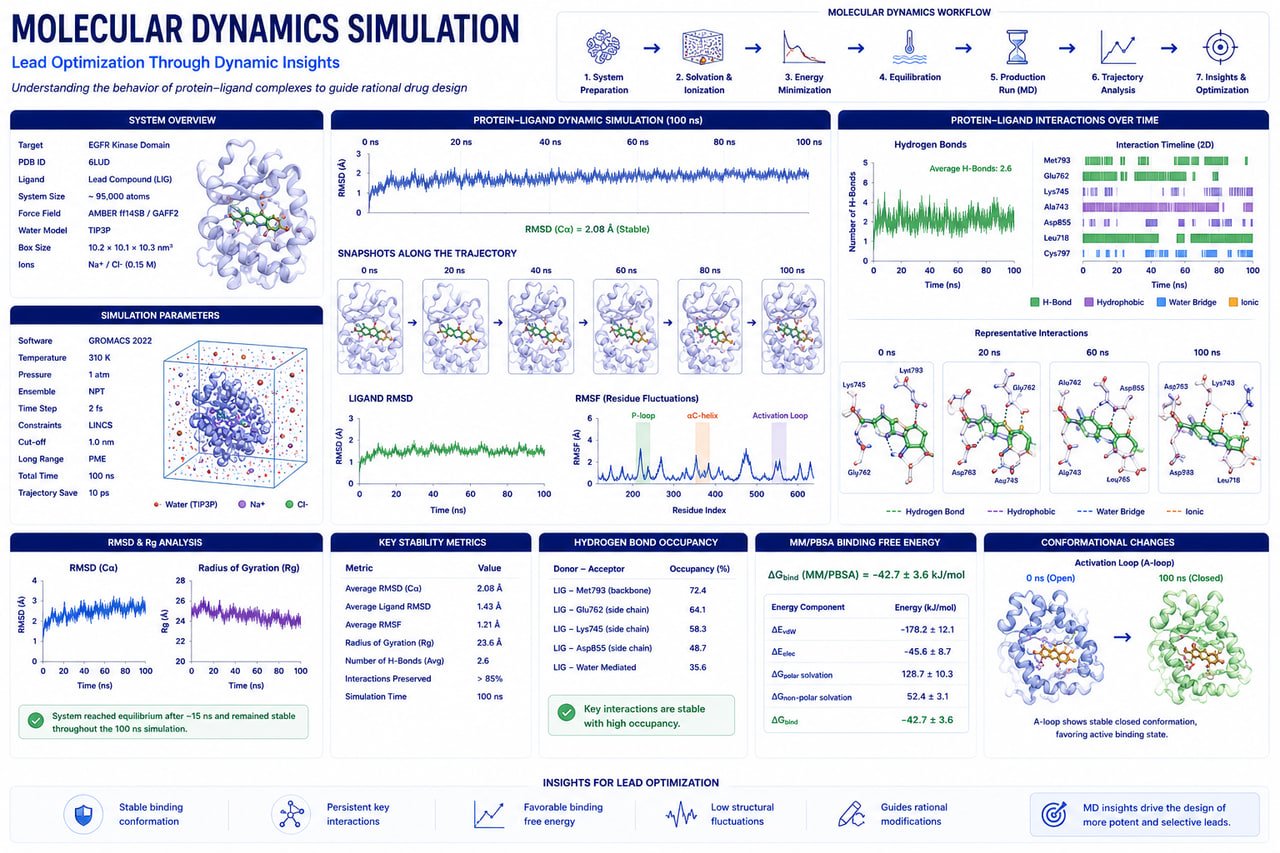
Molecular Dynamics Simulation

Accelerate drug discovery and biomolecular research with high-performance molecular dynamics simulations for protein structures, protein–ligand complexes, protein–protein interactions, antibodies, enzymes, and nucleic acid systems.

Capabilities

What We Deliver

Protein Stability AnalysisProtein–Ligand DynamicsProtein–Protein Interaction StudiesMM-PBSA Binding Energy Calculations100 ns, 500 ns & 1000 ns Simulations
Service Offerings

Simulation Categories

Protein Structure Dynamics

Evaluate protein stability, flexibility, conformational changes, and mutation effects.

Protein–Ligand Complex Simulations

Assess binding stability, interaction persistence, and drug-target dynamics.

Protein–Protein Complex Simulations

Investigate intermolecular interactions and complex stability.

Antibody–Antigen Simulations

Characterize therapeutic antibody interactions and epitope recognition.

Nucleic Acid Simulations

Study DNA/RNA–protein interactions and biomolecular mechanisms.

Process

Simulation Timescales

100 ns

Initial stability studies — RMSD, RMSF, hydrogen bonds.

500 ns

Detailed interaction analysis — PCA, DCCM, MM-PBSA.

1000 ns

Long-timescale conformational studies — FEL, clustering, essential dynamics.

Technology

Technology Stack

Molecular Dynamics Platforms

GROMACS
AMBER
CHARMM
OpenMM

Analysis Tools

MDAnalysis
CPPTRAJ
VMD
PyMOL
Bio3D

Infrastructure

Linux HPC Clusters
AWS Cloud
Google Cloud
GPU-Accelerated Computing
Applications

Applications in Drug Discovery

Lead optimization
Virtual screening validation
Binding mechanism studies
Drug repurposing
Hit-to-lead progression
Structure-based drug design
Applications

Applications in Structural Biology

Protein folding studies
Mutation analysis
Protein engineering
Antibody design
Mechanistic pathway studies
Deliverables

Scientific Deliverables

RMSD plots
RMSF plots
Radius of gyration analysis
Hydrogen bond occupancy plots
Free energy landscape maps
MM-PBSA binding energy reports
PCA and DCCM analyses
Publication-ready figures
Simulation trajectories
Sectors

Industries We Serve

Pharmaceutical Companies

Lead optimization and drug candidate validation.

Biotechnology Organizations

Protein engineering and biologics development.

CROs & CDMOs

Computational chemistry support.

Academic & Research Institutes

Structural biology and biomolecular research.

Precision Medicine Programs

Mechanistic therapeutic investigations.

Why RASA

Why Choose RASA?

AI-Assisted Bioinformatics

Machine learning-enabled workflows for biomarker discovery, variant prioritization, and predictive genomics.

Multi-Platform Expertise

Support for Illumina, Oxford Nanopore, PacBio HiFi, and 10x Genomics platforms.

End-to-End Analysis

From raw sequencing data to biological interpretation and publication-ready reports.

Cloud-Ready Infrastructure

Deployable on AWS, Google Cloud, HPC clusters, and secure on-premise environments.

Reproducible Workflows

Built using Nextflow, Snakemake, Docker, and Singularity for enterprise-grade bioinformatics operations.

Service FAQ

Frequently Asked Questions

Molecular Dynamics (MD) Simulation is a computational technique used to study the motion and behavior of atoms and molecules over time. Unlike molecular docking, which provides a static binding pose, MD simulations model real-time molecular interactions under physiological conditions. This allows researchers to evaluate protein stability, ligand binding, conformational changes, molecular flexibility, and biomolecular interactions at atomic resolution.
MD simulations are widely used in drug discovery, structural biology, protein engineering, antibody development, and biomolecular research.

RASA Life Science Informatics offers comprehensive Molecular Dynamics simulation services, including:
Protein Dynamics Simulations
Protein–Ligand Complex Simulations
Protein–Protein Interaction Simulations
Antibody–Antigen Simulations
DNA Simulations
RNA Simulations
Membrane Protein Simulations
Drug Discovery Simulations
Binding Free Energy Analysis
Conformational Dynamics Studies
Our workflows support pharmaceutical companies, biotechnology organizations, CROs, and academic research groups.

Molecular Dynamics simulations provide insights beyond molecular docking by evaluating how proteins and ligands behave over time. MD simulations help researchers:
Validate docking results
Assess binding stability
Investigate conformational changes
Understand protein flexibility
Predict molecular interactions
Improve lead optimization
Reduce experimental costs
These insights support rational drug design and therapeutic development.

We provide:
Protein Dynamics Simulations
Study protein flexibility, stability, and conformational behavior.
Protein–Ligand Complex Simulations
Evaluate ligand binding stability and interaction dynamics.
Protein–Protein Interaction Simulations
Investigate biomolecular complexes and interaction mechanisms.
Antibody–Antigen Simulations
Analyze antibody binding, epitope recognition, and immune interactions.
DNA & RNA Simulations
Study nucleic acid structure, dynamics, and molecular interactions.
Membrane Protein Simulations
Investigate GPCRs, ion channels, transporters, and membrane-associated proteins.

Simulation lengths are selected according to project objectives:
100 ns Simulations – Initial stability assessment
250 ns Simulations – Extended interaction analysis
500 ns Simulations – Advanced conformational studies
1000 ns (1 μs) Simulations – Long-timescale molecular investigations
Custom simulation lengths can also be provided depending on research requirements.

Our workflows utilize industry-leading simulation software including:
GROMACS
AMBER
OpenMM
NAMD
We also use validated force fields such as:
CHARMM
AMBER Force Fields
OPLS-AA
GROMOS

Yes. Molecular docking predicts a potential binding pose, while Molecular Dynamics simulations evaluate whether that interaction remains stable over time under realistic biological conditions.
Combining docking and MD simulations improves confidence in hit selection and reduces false-positive predictions.

Root Mean Square Deviation (RMSD) measures structural changes in a molecule over time relative to a reference structure. RMSD is one of the most widely used metrics for evaluating simulation stability and assessing whether a system has reached equilibrium.

Root Mean Square Fluctuation (RMSF) measures residue-level flexibility during a simulation. RMSF helps identify highly dynamic regions, flexible loops, binding sites, and functionally important protein domains.

Radius of Gyration (Rg) measures the compactness of a molecular structure throughout a simulation. Changes in Rg can indicate folding, unfolding, structural stabilization, or conformational transitions.

Hydrogen Bond analysis evaluates the formation, occupancy, and stability of hydrogen bonds during simulations. Stable hydrogen bonding patterns often correlate with stronger molecular interactions and improved binding affinity.

Principal Component Analysis (PCA) identifies dominant collective motions within proteins and biomolecular systems. PCA helps researchers understand large-scale conformational changes and biologically relevant movements.

DCCM analysis evaluates correlated and anti-correlated motions between residues within a protein structure. This analysis helps reveal communication pathways, allosteric effects, and dynamic relationships between protein regions.

MM-PBSA (Molecular Mechanics Poisson–Boltzmann Surface Area) and MM-GBSA (Molecular Mechanics Generalized Born Surface Area) are computational methods used to estimate binding free energies between proteins and ligands.
These analyses help:
Rank compounds
Evaluate binding affinity
Support lead optimization
Prioritize drug candidates

Typical deliverables include:
RMSD Plots
RMSF Plots
Radius of Gyration Analysis
Hydrogen Bond Occupancy Analysis
Principal Component Analysis (PCA)
Dynamic Cross-Correlation Matrix (DCCM)
Free Energy Landscape Maps
MM-PBSA/MM-GBSA Reports
Simulation Trajectories
Interaction Analysis Reports
Publication-Ready Figures
Comprehensive Scientific Reports
Deliverables can be customized according to project requirements.

We commonly work with:
PDB Files
MOL2 Files
SDF Files
GRO Files
TOP Files
Trajectory Files (.xtc, .trr, .dcd)
Docking Results
Experimental Structures
Custom formats can also be accommodated.

Our simulation workflows support:
Oncology
Infectious Diseases
Neuroscience
Autoimmune Disorders
Cardiometabolic Diseases
Rare Diseases
Antimicrobial Drug Discovery
Precision Medicine Programs
Both small-molecule and biologics-based discovery programs benefit from MD simulations.

RASA combines expertise in structural biology, computational chemistry, molecular modeling, and drug discovery to deliver high-quality Molecular Dynamics simulation services. Our cloud-enabled infrastructure, advanced analytical workflows, publication-ready reporting, and experience across pharmaceutical, biotechnology, and academic projects help researchers gain deeper insights into biomolecular behavior and therapeutic interactions.
📧 info@rasalifesciences.com
🌐 www.rasalifesciences.com

Ready to partner with a trusted bioinformatics company in India?

Get in touch with our team in Pune, India to discuss sample sizes, platform details, and custom bioinformatics pipeline configurations for your research program.

Start a Project