
Computational Genomics & NGS

Multi-Omics Integration

AI-Powered Multi-Omics Data Integration for Systems Biology, Biomarker Discovery & Precision Medicine
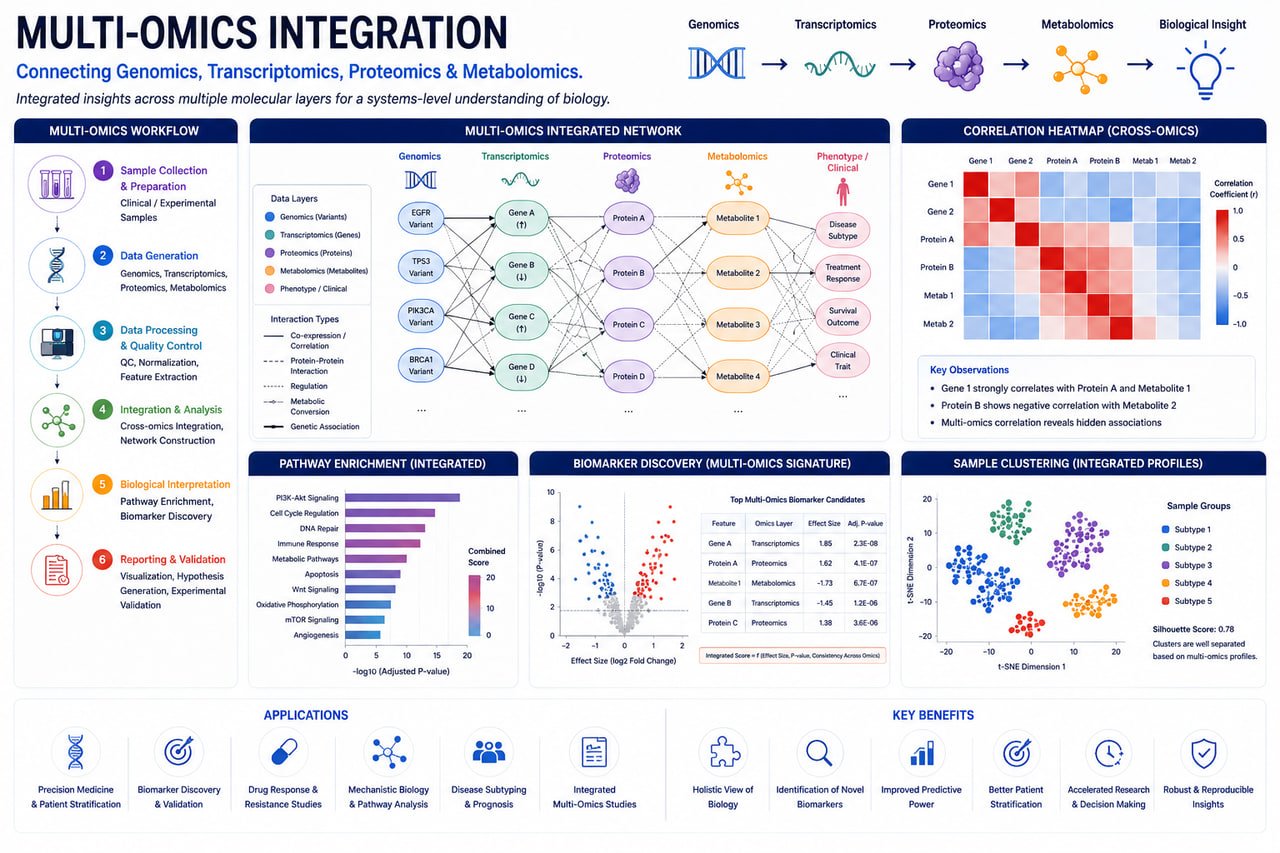
Multi-Omics Integration

RASA Life Science Informatics provides advanced Multi-Omics Integration services that combine genomics, transcriptomics, epigenomics, proteomics, metabolomics, and clinical data to deliver a comprehensive understanding of complex biological systems and disease mechanisms.

Modern biomedical research generates vast amounts of multi-dimensional data. However, true biological insights emerge when these datasets are integrated and interpreted together. Our AI-powered multi-omics workflows help pharmaceutical companies, biotechnology organizations, hospitals, CROs, and academic researchers uncover molecular interactions, identify biomarkers, discover therapeutic targets, and accelerate precision medicine initiatives.

By integrating multiple biological layers into unified analytical frameworks, we reveal relationships between genes, transcripts, proteins, metabolites, pathways, and phenotypes that remain hidden in single-omics studies.

Service Offerings

Multi-Omics Integration Services

Genomics & Transcriptomics Integration

Connect genetic variation with gene expression profiles to understand disease mechanisms and regulatory processes.

  • Variant-expression association analysis
  • eQTL analysis
  • Regulatory network analysis
  • Disease gene prioritization
  • Functional interpretation

Transcriptomics & Proteomics Integration

Link gene expression patterns with protein abundance and functional activity.

  • Correlation analysis
  • Protein pathway mapping
  • Differential expression integration
  • Biomarker discovery
  • Functional systems analysis

Epigenomics Integration

Investigate how epigenetic modifications influence gene regulation and cellular function.

  • DNA methylation integration
  • ATAC-seq integration
  • ChIP-seq integration
  • Regulatory genomics analysis
  • Chromatin accessibility studies

Multi-Modal Single-Cell Integration

Combine multiple single-cell datasets for comprehensive cellular characterization.

  • scRNA-seq integration
  • scATAC-seq integration
  • Multiome analysis
  • Cell-state characterization
  • Cellular trajectory analysis

Clinical & Translational Omics

Integrate molecular and clinical data to support precision medicine and therapeutic discovery.

  • Patient stratification
  • Disease subtype classification
  • Clinical outcome prediction
  • Biomarker validation
  • Precision medicine analytics
Capabilities

Key Features

Genomics, Transcriptomics & Epigenomics Integration
Proteomics & Metabolomics Analytics
Single-Cell Multiomics Analysis
AI-Assisted Biomarker Discovery
Systems Biology & Network Analysis
Precision Medicine Applications
Cloud-Ready Reproducible Pipelines
Publication-Ready Reports & Visualizations
Deliverables

Deliverables

Integrated Omics Reports

Multi-Omics Integration Reports
Molecular Network Analysis
Pathway Enrichment Analysis
Biomarker Discovery Reports
Target Prioritization Results

Advanced Analytics

Multi-Layer Biological Networks
Disease Mechanism Analysis
Patient Stratification Models
Predictive Analytics Reports
Precision Medicine Insights

Visualization & Reporting

Multi-Omics Heatmaps
Network Interaction Maps
Pathway Visualizations
PCA & Clustering Analysis
Publication-Ready Figures
Executive Scientific Reports
Applications

Applications

Precision Medicine

Patient stratification and personalized therapeutic development.

Biomarker Discovery

Identification of diagnostic, prognostic, and predictive biomarkers.

Drug Discovery

Target identification, pathway analysis, and therapeutic prioritization.

Cancer Research

Integrated analysis of genomic, transcriptomic, and epigenomic alterations.

Rare Disease Research

Multi-layer molecular characterization of complex genetic disorders.

Systems Biology

Network-based understanding of biological processes and disease mechanisms.

Technology

Technologies & Platforms

Omics Data Analysis

R / Bioconductor
Python
Scanpy
Seurat
DESeq2

Systems Biology & Networks

Cytoscape
STRING
Reactome
KEGG
Gene Ontology

Multi-Omics Integration Platforms

MOFA+
mixOmics
iClusterPlus
DIABLO
MultiAssayExperiment

Infrastructure

Nextflow
Snakemake
Docker
AWS
Google Cloud
HPC Clusters
Highlights

Representative Analysis Outputs

Biomarker Discovery

Identification of clinically relevant biomarkers across multiple molecular layers.

Disease Mechanism Elucidation

Understanding complex disease biology through integrated molecular analysis.

Therapeutic Target Discovery

Identification and prioritization of actionable therapeutic targets.

Precision Medicine Models

Development of patient-specific molecular signatures.

Systems Biology Insights

Network-based interpretation of biological pathways and disease processes.

Why RASA

Why Choose RASA?

AI-Assisted Bioinformatics

Machine learning-enabled workflows for biomarker discovery, variant prioritization, and predictive genomics.

Multi-Platform Expertise

Support for Illumina, Oxford Nanopore, PacBio HiFi, and 10x Genomics platforms.

End-to-End Analysis

From raw sequencing data to biological interpretation and publication-ready reports.

Cloud-Ready Infrastructure

Deployable on AWS, Google Cloud, HPC clusters, and secure on-premise environments.

Reproducible Workflows

Built using Nextflow, Snakemake, Docker, and Singularity for enterprise-grade bioinformatics operations.

Service FAQ

Frequently Asked Questions

Multi-Omics Integration is the process of combining multiple biological data types—including genomics, transcriptomics, epigenomics, proteomics, metabolomics, and clinical data—to gain a comprehensive understanding of biological systems and disease mechanisms. By integrating different molecular layers, researchers can uncover complex biological relationships that are often missed when analyzing a single dataset. Multi-omics approaches are widely used in precision medicine, biomarker discovery, drug development, cancer research, and systems biology.

Biological processes are regulated across multiple molecular levels. Genomic mutations, gene expression changes, epigenetic modifications, protein abundance, and metabolic alterations all contribute to disease progression and therapeutic response.
Multi-omics integration helps researchers:
Understand disease mechanisms
Identify therapeutic targets
Discover clinically relevant biomarkers
Improve patient stratification
Support precision medicine initiatives
Accelerate drug discovery programs
This systems-level approach provides a more complete view of disease biology than any individual omics technology alone.

RASA Life Science Informatics offers comprehensive multi-omics analysis services including:
Genomics & Transcriptomics Integration
Transcriptomics & Proteomics Integration
Epigenomics Integration
Single-Cell Multiomics Analysis
Spatial Multiomics Integration
Clinical Multi-Omics Analytics
Disease Network Analysis
Pathway Enrichment Analysis
Biomarker Discovery
AI-Powered Predictive Modeling
Precision Medicine Analytics
Our workflows are customized for pharmaceutical companies, biotechnology organizations, hospitals, CROs, and academic research institutions.

Biomarker Discovery is the process of identifying measurable biological indicators associated with disease diagnosis, prognosis, therapeutic response, or disease progression. Biomarkers can be derived from genes, transcripts, proteins, metabolites, epigenetic signatures, or integrated multi-omics datasets.
Biomarkers play a crucial role in:
Early Disease Detection
Precision Medicine
Drug Development
Clinical Trial Stratification
Companion Diagnostics
Treatment Response Monitoring

We support the discovery and validation of:
Diagnostic Biomarkers
Used to detect or confirm the presence of disease.
Prognostic Biomarkers
Used to predict disease progression and patient outcomes.
Predictive Biomarkers
Used to identify patients likely to respond to specific therapies.
Companion Diagnostics
Biomarkers that support targeted therapeutic decisions.
Precision Medicine Biomarkers
Patient-specific molecular signatures that guide personalized treatment strategies.

Our workflows support a wide range of biological and clinical datasets, including:
RNA-Seq
Whole Genome Sequencing (WGS)
Whole Exome Sequencing (WES)
Single-Cell RNA Sequencing (scRNA-seq)
Single-Cell Multiomics
Spatial Transcriptomics
ATAC-Seq
ChIP-Seq
DNA Methylation Data
Proteomics
Metabolomics
Clinical Metadata
Electronic Health Records (EHR)
Public Omics Repositories
These datasets can be analyzed individually or integrated into unified multi-omics frameworks.

Single-Cell Multiomics combines multiple molecular measurements from individual cells, such as gene expression, chromatin accessibility, protein abundance, and epigenetic modifications. This approach provides a detailed understanding of cellular heterogeneity, cell-state transitions, and disease-associated cellular mechanisms.
Applications include cancer biology, immunology, neuroscience, and regenerative medicine.

Yes. Multi-omics integration is one of the most powerful approaches for precision medicine because it combines molecular and clinical information to identify patient-specific disease mechanisms and therapeutic opportunities.
Applications include:
Patient Stratification
Personalized Treatment Selection
Disease Risk Prediction
Clinical Outcome Modeling
Biomarker-Guided Therapeutics

Multi-omics analysis helps drug discovery teams:
Identify Novel Therapeutic Targets
Understand Disease Pathways
Discover Predictive Biomarkers
Prioritize Drug Candidates
Investigate Drug Mechanisms of Action
Improve Clinical Trial Design
By integrating multiple molecular datasets, researchers gain deeper insights into disease biology and therapeutic response.

Our biomarker discovery workflows may include:
Differential Expression Analysis
Machine Learning Feature Selection
Survival Analysis
Predictive Modeling
Pathway Enrichment Analysis
Network Biology Analysis
Multi-Omics Integration
Statistical Validation
Clinical Association Studies
These approaches help identify robust and clinically relevant biomarkers.

Multi-omics approaches are widely used in:
Oncology
Cancer biomarker discovery, tumor profiling, and precision oncology.
Neurological Disorders
Alzheimer’s disease, Parkinson’s disease, and neurodevelopmental disorders.
Autoimmune Diseases
Immune regulation and inflammatory disease research.
Infectious Diseases
Host-pathogen interaction studies and therapeutic target discovery.
Cardiometabolic Diseases
Diabetes, obesity, and cardiovascular disease research.
Rare Diseases
Molecular characterization and biomarker identification.

Our workflows utilize leading bioinformatics and multi-omics platforms including:
Multi-Omics Integration
MOFA+
mixOmics
DIABLO
iClusterPlus
MultiAssayExperiment
Statistical & Machine Learning
R
Python
Scikit-Learn
XGBoost
TensorFlow
Systems Biology
Cytoscape
STRING
Reactome
KEGG
Workflow Infrastructure
Nextflow
Snakemake
Docker
AWS
Google Cloud

Typical project deliverables include:
Biomarker Discovery Reports
Candidate Biomarker Lists
Predictive Models
Multi-Omics Integration Reports
Molecular Network Analysis
Pathway Enrichment Results
Patient Stratification Models
Survival Analysis Reports
Publication-Ready Figures
Executive Scientific Reports
Deliverables can be customized according to project goals and regulatory requirements.

Yes. We routinely integrate molecular datasets with clinical variables such as patient outcomes, treatment response, disease stage, demographics, and phenotypic information. This approach improves biomarker discovery, predictive modeling, and translational research outcomes.

RASA combines expertise in genomics, transcriptomics, epigenomics, proteomics, systems biology, machine learning, and precision medicine to deliver comprehensive multi-omics solutions. Our scalable cloud-ready workflows, advanced analytics, publication-ready reporting, and translational research expertise help organizations transform complex biological data into actionable insights.
📧 info@rasalifesciences.com
🌐 www.rasalifesciences.com

Ready to partner with a trusted bioinformatics company in India?

Get in touch with our team in Pune, India to discuss sample sizes, platform details, and custom bioinformatics pipeline configurations for your research program.

Start a Project