Introduction
Drug discovery remains one of the most challenging and resource-intensive processes in pharmaceutical research. Developing a new therapeutic molecule typically requires more than a decade of research and billions of dollars in investment, while the majority of candidates fail during preclinical or clinical development. A significant proportion of failures can be attributed to inadequate target selection, insufficient efficacy, unexpected toxicity, and poor pharmacokinetic properties.
Recent advances in artificial intelligence (AI), machine learning (ML), structural biology, and computational chemistry are transforming this paradigm by enabling faster and more informed decision-making throughout the drug discovery pipeline. AI-driven approaches now support target identification, virtual screening, molecular docking, molecular dynamics simulations, ADMET prediction, and de novo molecule generation, substantially reducing discovery timelines and improving candidate quality.
The Growing Need for AI in Drug Discovery
Traditional drug discovery relies heavily on experimental screening and iterative optimization. Despite advances in high-throughput screening technologies, identifying viable drug candidates remains expensive and inefficient.
Key challenges include:
- Large chemical search spaces: The number of potentially drug-like molecules is estimated to be around \(10^{60}\), making experimental evaluation of even a fraction of this space impossible.
- Complex disease biology: Untangling the multi-factorial and non-linear networks underlying human disease requires computational models.
- Multi-target disease mechanisms: Traditional "one disease, one target" approaches often fail in complex indications such as cancer or neurodegeneration.
- Low clinical success rates: Over 90% of candidates entering clinical trials fail, often due to lack of efficacy or safety issues.
- Increasing R&D costs: Eroom's law describes the declining efficiency of pharmaceutical R&D, showing that costs double approximately every nine years.
Artificial intelligence enables researchers to analyze vast biological and chemical datasets, uncover hidden relationships, and prioritize high-confidence targets and compounds for further investigation. AI models can integrate genomic, transcriptomic, proteomic, structural, and clinical data to generate actionable insights that would be difficult to obtain through conventional approaches alone.
AI-Driven Target Identification and Validation
Target identification is the foundation of every successful drug discovery program. Selecting biologically relevant and druggable targets significantly increases the probability of downstream success. AI platforms leverage multi-omics datasets, protein–protein interaction networks, disease association databases, clinical genetics evidence, and scientific literature mining.
Machine learning models can prioritize disease-associated genes and proteins by integrating evidence from multiple sources. Network-based approaches further identify hub proteins and critical signaling pathways that may represent promising therapeutic intervention points.
Key Biological Databases Utilized:
Structure-Based Drug Discovery and Protein Modeling
The emergence of advanced protein structure prediction methods has dramatically expanded the number of therapeutically tractable targets. Recent breakthroughs in structural biology allow researchers to predict protein structures with high accuracy, identify druggable binding pockets, characterize active sites, evaluate protein flexibility, and model protein–ligand interactions.
Predicted structures can subsequently be used for docking studies, virtual screening campaigns, and molecular dynamics simulations to guide rational drug design. AI-assisted structural biology is particularly valuable for targets lacking experimentally determined crystal structures, such as complex transmembrane GPCRs or dynamic multi-protein complexes.
"AI structural modeling tools like AlphaFold and ESMFold have solved the 50-year-old protein folding challenge, unlocking structural coordinates for virtually all cataloged proteins."
Virtual Screening and Molecular Docking
Virtual screening enables rapid evaluation of millions of compounds against a biological target. By prioritizing compounds with favorable binding characteristics, virtual screening significantly reduces the number of molecules requiring experimental validation in high-throughput screening (HTS) assays.
Computational screening strategies include:
- Structure-Based Virtual Screening (SBVS): Simulating the 3D interaction of small molecules within a target's binding pocket. This involves scoring protein-ligand docking poses, estimating binding affinity, and structural interaction profiling.
- Ligand-Based Virtual Screening (LBVS): Relying on known active compounds when the target structure is unknown. This leverages pharmacophore modeling, chemical similarity analysis, and machine learning classification models.
These computational methods allow search across massive compound databases including ChEMBL, DrugBank, ZINC, and Enamine REAL to identify diverse scaffolds for target validation.
Molecular Dynamics Simulation for Lead Validation
Docking provides a static representation of binding interactions. However, biological systems are dynamic. Molecular Dynamics (MD) simulations allow researchers to evaluate binding stability, conformational changes, hydrogen bond persistence, protein flexibility, and free energy landscapes.
Key analyses commonly performed during lead validation include:
- RMSD (Root Mean Square Deviation): Evaluating the structural deviation and equilibrium status of the target protein.
- RMSF (Root Mean Square Fluctuation): Quantifying local flexibility of individual amino acid residues.
- Radius of Gyration (Rg): Assessing overall protein compactness and stability.
- Free Energy Estimation (MM-PBSA & MM-GBSA): Calculating thermodynamic binding affinities of lead complexes over the simulation trajectory.
MD simulations provide valuable insights into ligand behavior under physiologically relevant conditions (solvent, temperature, pressure) and improve confidence in lead selection prior to chemical synthesis.
De Novo Drug Design Using Generative AI
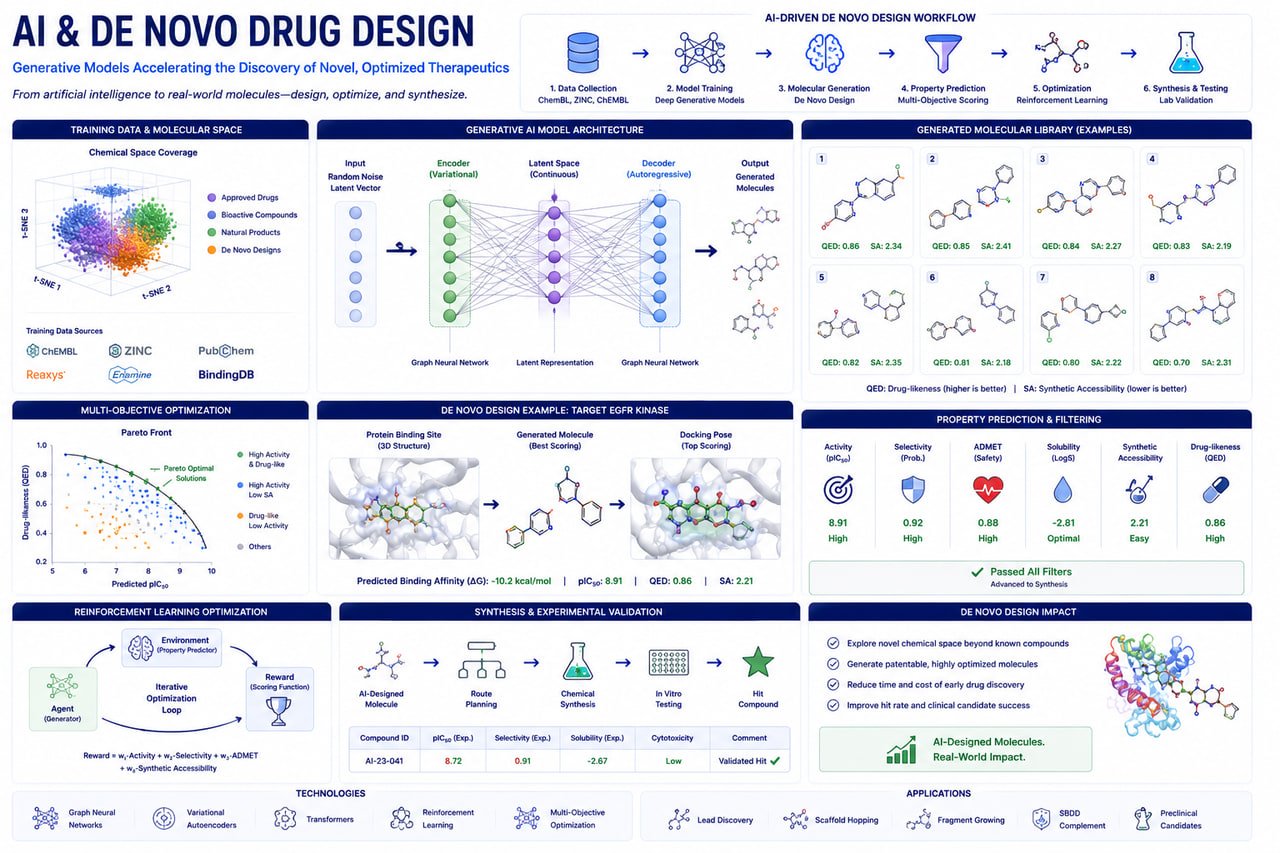
One of the most transformative applications of AI in drug discovery is de novo molecule generation. Generative models can design entirely new chemical structures optimized for target affinity, selectivity, drug-likeness, synthetic accessibility, and ADMET properties.
Common generative AI architectures include:
- Graph Neural Networks (GNNs): Representing molecules as molecular graphs for molecular property prediction and generation.
- Variational Autoencoders (VAEs): Mapping discrete chemical structures to a continuous latent space for smooth optimization.
- Generative Adversarial Networks (GANs): Utilizing generator and discriminator networks to produce high-quality novel molecules.
- Transformer Models: Treating chemical notation (SMILES strings) as a language, predicting new structures sequence-by-sequence.
- Reinforcement Learning Systems: Guiding generative models toward multi-parameter goals using reward feedback.
Unlike traditional screening approaches that search existing chemical libraries, de novo design explores previously uncharacterized chemical space, increasing the likelihood of identifying novel patentable therapeutic candidates.
Multi-Target Drug Discovery and Network Pharmacology
Many complex diseases involve redundant biological networks rather than single molecular targets. Single-target agents often fail due to drug resistance or compensatory pathway activation, particularly in oncology, Alzheimer's disease, diabetes, and autoimmune disorders.
Network pharmacology combines systems biology and AI to identify disease modules, hub genes, target combinations, and drug-target-pathway relationships. This systems-level perspective enables the rational development of multi-target therapies with improved efficacy and reduced resistance profiles.
AI-Powered ADMET and Toxicity Prediction
A major cause of drug development failure is toxicity and poor pharmacokinetic performance during clinical phases. AI-based ADMET platforms can predict absorption, distribution, metabolism, excretion, and toxicity parameters early in the discovery pipeline.
Modern models support mutagenicity prediction (Ames test), carcinogenicity assessment, hERG channel liability (cardiotoxicity), and ICH M7 impurity evaluation. Early identification of safety risks reduces costly late-stage failures and supports more efficient lead optimization strategies.
Future Directions
Several emerging technologies are expected to further transform drug discovery:
- Foundation Models for Biology: Large-scale models trained on millions of protein sequences, structures, and cellular states that generalize across biological tasks.
- Autonomous Drug Discovery Platforms: Integration of AI, robotics, and laboratory automation to form closed-loop "self-driving labs."
- Digital Biology: Real-time simulation of biological systems at cell and tissue scale for predictive medicine.
- AI-Driven Precision Therapeutics: Designing patient-specific therapeutics using patient-specific genomic and transcriptomic signatures.
Conclusion
Artificial intelligence is reshaping every stage of drug discovery, from target identification and protein structure modeling to virtual screening, molecular dynamics simulation, and de novo molecule generation. By integrating computational biology, machine learning, structural bioinformatics, and systems pharmacology, researchers can accelerate therapeutic development while reducing costs and improving candidate quality. As AI technologies continue to mature, they are expected to play a central role in the next generation of precision medicine and intelligent drug discovery.
How RASA Can Help
RASA Life Science Informatics provides end-to-end computational drug discovery solutions, combining cutting-edge computational chemistry, structural biology, and custom machine learning pipelines.