
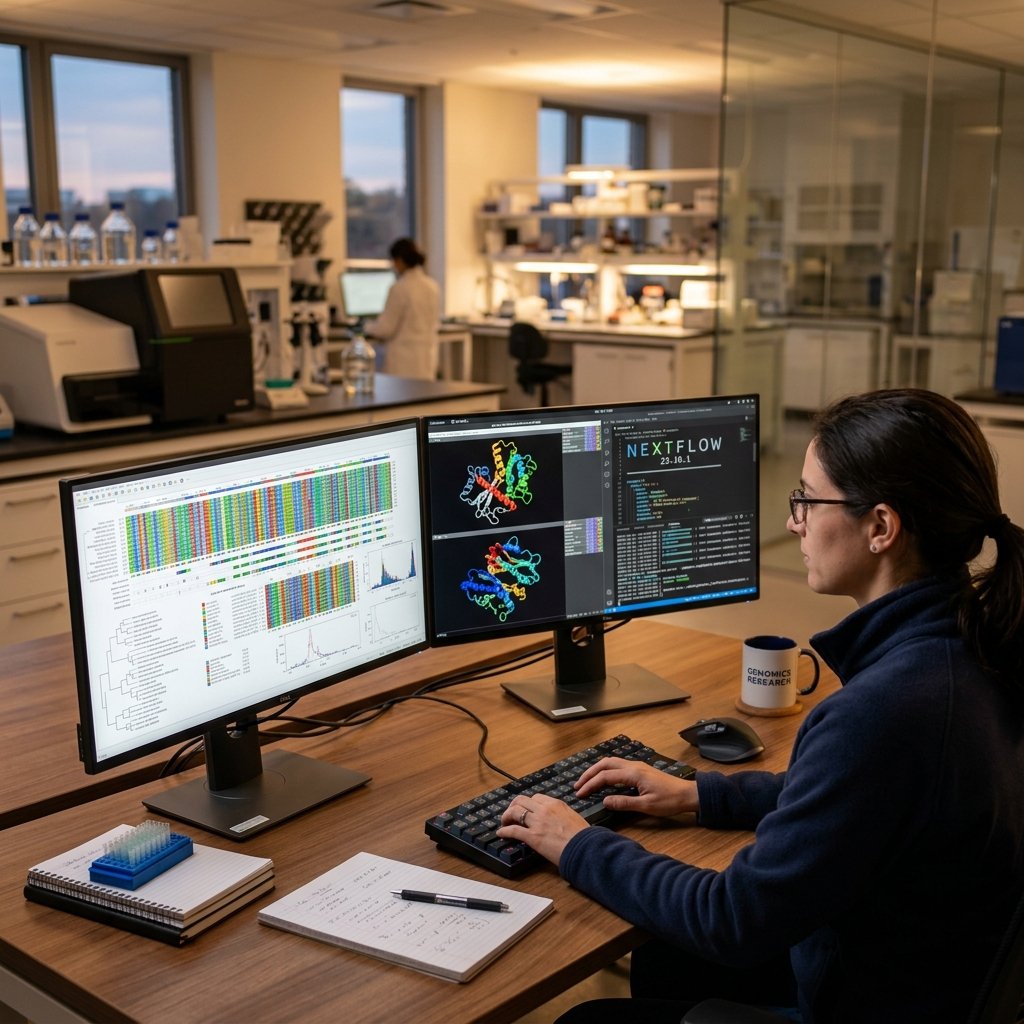
Executive Summary
Artificial Intelligence (AI) and Machine Learning (ML) are transforming modern drug discovery by enabling rapid target identification, virtual screening, toxicity prediction, biomarker discovery, and lead optimization. However, the success of AI-driven drug discovery is highly dependent on one critical factor: data quality.
While significant attention is often focused on AI algorithms, studies consistently demonstrate that data selection, curation, normalization, and feature engineering contribute more to model performance than the choice of machine learning architecture itself. Poorly curated datasets introduce bias, reduce model generalizability, and frequently lead to inaccurate predictions.
Introduction
The pharmaceutical industry generates enormous amounts of biological and chemical data every day. These data originate from high-throughput screening campaigns, genomics studies, transcriptomics experiments, proteomics analyses, clinical trials, scientific literature, and public databases.
The availability of large datasets has fueled the adoption of AI and ML technologies throughout drug discovery. Applications include drug target identification, drug repurposing, toxicity prediction, molecular property prediction, virtual screening, biomarker discovery, and precision medicine.
However, the effectiveness of AI models depends heavily on the quality of training data. Even the most sophisticated neural network cannot compensate for incomplete, noisy, inconsistent, or biased datasets.
Why Data Matters More Than Algorithms
Many organizations invest heavily in AI infrastructure while overlooking data quality. In practice, high-quality data combined with simple models often outperforms poor-quality data paired with complex models.
The majority of effort in AI projects is spent on data collection, data cleaning, data standardization, annotation, and feature generation. Industry analyses suggest that data preparation frequently consumes up to 80% of the total machine learning project lifecycle.
Common Challenges in Biological and Chemical Datasets
1. Data Heterogeneity
Drug discovery datasets originate from multiple sources (ChEMBL, PubChem, DrugBank, GEO, TCGA, clinical databases, and literature reports). Challenges include different formats, varying identifiers (e.g. gene symbols vs. Entrez IDs), missing metadata, and conflicting measurements.
2. Experimental Variability
Biological experiments often differ in laboratory protocols, instrument platforms, sample preparation methods, and analysis pipelines. This variability introduces significant noise into predictive models, making cross-study validation challenging.
3. Missing Values
Common issues include missing assay endpoints, incomplete molecular descriptors, missing clinical annotations, and unavailable omics measurements. Model training requires systematic strategies to impute or filter missing features.
4. Class Imbalance
Many drug discovery datasets contain very few active compounds (hits) and large numbers of inactive compounds. This severe class imbalance can bias model training, leading to high false-negative rates unless addressed through specialized loss functions or sampling techniques.
5. Data Bias
Bias can arise from historical screening preferences, underrepresented chemical scaffolds, population-specific genomic datasets, and publication bias (where negative results are rarely published). This limits the generalizability of models to novel chemical space or diverse patient cohorts.
Data Sources for AI-Powered Drug Discovery
Integrating diverse data streams is crucial for modeling biological systems. Key databases utilized in RASA workflows include:
| Category | Databases | Data Types |
|---|---|---|
| Chemical | ChEMBL, PubChem, DrugBank, ZINC, Enamine REAL | Chemical structures, bioactivity endpoints, ADMET properties, physical descriptors |
| Biological | TCGA, GEO, SRA, GTEx, PRIDE, ProteomicsDB, KEGG, Reactome, STRING, BioGRID | Genomics, transcriptomics (RNA-Seq), epigenomics, proteomics, pathway topologies, protein-protein networks |
| Clinical | ClinicalTrials.gov, FDA Drug Labels, Electronic Health Records, RWE Datasets | Trial NCT details, indications, biomarkers, real-world cohort observations |
Practical Data Preparation Workflow
To transform raw datasets into AI-ready structures, RASA implements a rigorous multi-step preparation pipeline:
Building Predictive Models
Once datasets are AI-ready, various machine learning architectures can be applied based on the underlying structure of the features:
Best Practices for AI-Ready Data
- Maintain Data Provenance: Track the entire lifecycle of each dataset, including primary sources, experimental protocols, and all transformation pipelines.
- Adhere to FAIR Principles: Ensure scientific data is Findable, Accessible, Interoperable, and Reusable to maximize multi-site collaboration.
- Handle Class Imbalance Carefully: Utilize techniques like SMOTE (Synthetic Minority Over-sampling Technique), focal loss, or chemical scaffold clustering to balance active classes.
- Prevent Data Leakage: Ensure validation and test sets are completely isolated from feature extraction, normalization parameters, or highly similar chemical scaffolds.
- Validate Continuously: Periodically update predictive models with new experimental validation coordinates to maintain relevance.
Conclusion
Artificial Intelligence is reshaping drug discovery, but successful implementation depends fundamentally on high-quality data. Data selection, cleaning, standardization, and integration remain the most critical steps in building predictive models that deliver meaningful scientific insights.
Organizations that invest in robust data preparation workflows will achieve higher predictive accuracy, better target prioritization, reduced experimental costs, and faster drug discovery timelines. Data quality is and will remain the foundation upon which successful predictive models are built.
References
- 1. Vamathevan J, Clark D, Czodrowski P, et al. Applications of Machine Learning in Drug Discovery and Development. Nature Reviews Drug Discovery. 2019;18(6):463–477.
- 2. Chen H, Engkvist O, Wang Y, Olivecrona M, Blaschke T. The Rise of Deep Learning in Drug Discovery. Drug Discovery Today. 2018;23(6):1241–1250.
- 3. Jumper J, Evans R, Pritzel A, et al. Highly Accurate Protein Structure Prediction with AlphaFold. Nature. 2021;596:583–589.
- 4. Stokes JM, Yang K, Swanson K, et al. A Deep Learning Approach to Antibiotic Discovery. Cell. 2020;180(4):688–702.
- 5. Wilkinson MD, Dumontier M, Aalbersberg IJ, et al. The FAIR Guiding Principles for Scientific Data Management and Stewardship. Scientific Data. 2016;3:160018.
Partner with RASA for AI-Ready Data Curation
Building predictive pipelines requires specialized informatics architectures. RASA provides complete biological and chemical data curation, feature engineering, and predictive modeling services.