In-Silico Drug Discovery

AI-Powered Computational Drug Discovery

Computational Drug Discovery, Molecular Modeling & AI Drug Design Solutions for Pharmaceutical, Biotechnology & CRO Organizations
AI-Powered Computational Drug Discovery

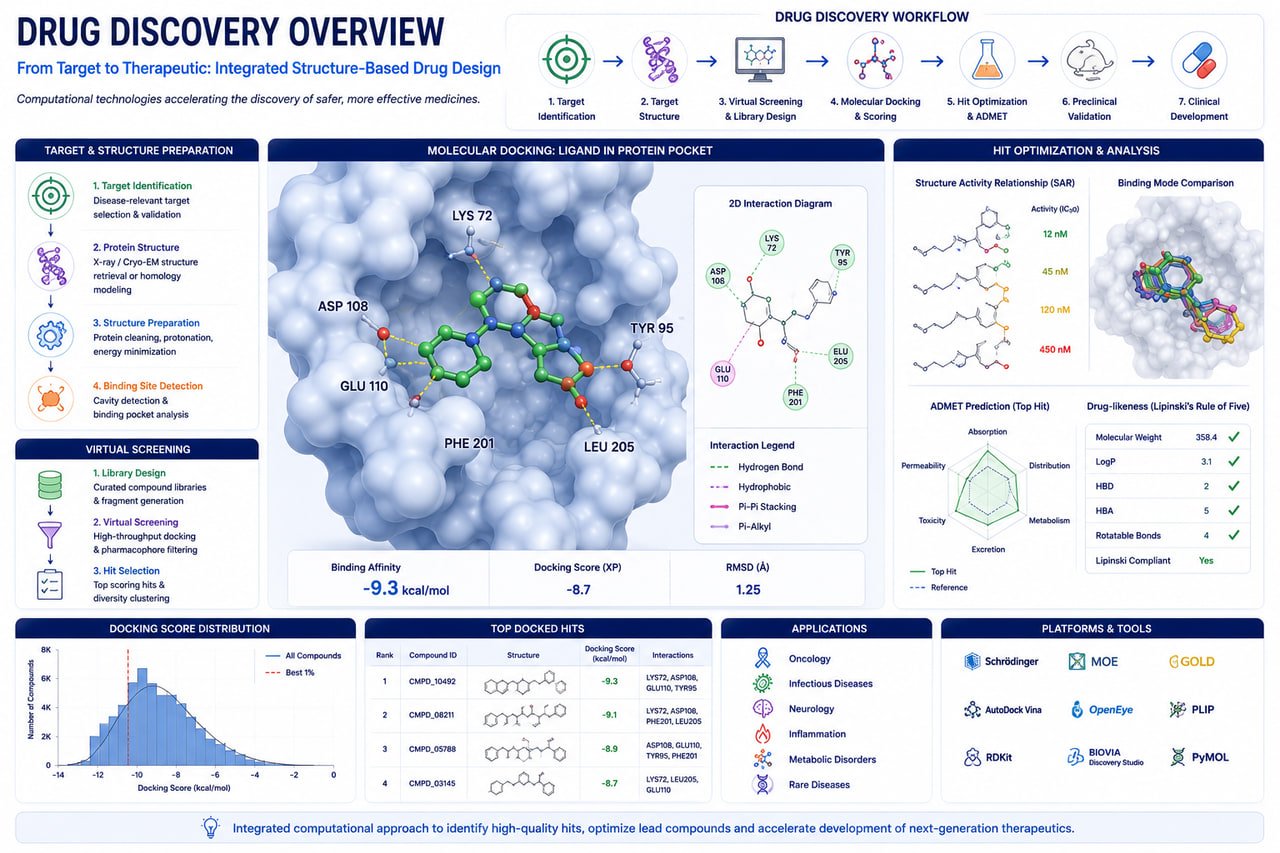
Accelerate therapeutic innovation through advanced computational drug discovery services including target identification, protein structure modeling, virtual screening, molecular docking, molecular dynamics simulations, AI-driven drug design, network pharmacology, and regulatory toxicology.

RASA Life Science Informatics provides end-to-end computational drug discovery solutions supporting pharmaceutical companies, biotechnology organizations, CROs, healthcare innovators, and academic research institutes worldwide โ€” combining structural bioinformatics, cheminformatics, artificial intelligence, systems biology, and computational toxicology.

Capabilities

Trusted Drug Discovery Capabilities

Virtual Screening of Millions of Compounds
Molecular Dynamics Simulations up to 1000 ns
AI-Powered Drug Design & Lead Optimization
QSAR Toxicology & ICH M7 Assessment
Multi-Omics Driven Target Discovery
Global Scientific Collaboration & Research Support
Service Offerings

Our Core Drug Discovery Services

Target Identification & Structure-Based Design

Identify biologically relevant therapeutic targets using genomics, transcriptomics, proteomics, systems biology, and AI-powered knowledge mining.

  • โœ“Multi-omics target discovery
  • โœ“Target druggability assessment
  • โœ“Pathway vulnerability analysis
  • โœ“Target validation support
  • โœ“Systems biology networks

Technologies & Pipelines

STRING Cytoscape Reactome KEGG DisGeNET
Explore Service

Virtual Screening & Docking

Screen large chemical libraries against target structures using structure-based and ligand-based virtual screening.

  • โœ“Structure-based screening
  • โœ“Ligand-based screening
  • โœ“Molecular docking (high-throughput)
  • โœ“Binding energy estimation
  • โœ“Lead prioritization

Technologies & Pipelines

AutoDock Vina smina QuickVina2 CB-Dock2 PyMOL
Explore Service

Molecular Dynamics Simulations

Simulate protein-ligand interactions, compute binding free energies, analyze conformational stability, and evaluate pocket dynamics.

  • โœ“Conformational stability analysis
  • โœ“Binding free energy calculation
  • โœ“Protein-ligand dynamics
  • โœ“Trajectory analysis
  • โœ“Binding pocket flexibility

Technologies & Pipelines

GROMACS AMBER OpenMM PyMOL Bio3D
Explore Service

Protein Structure Modeling

Generate and refine protein structures for drug discovery and structural biology research.

  • โœ“AlphaFold structure prediction
  • โœ“Homology modeling
  • โœ“Binding pocket prediction
  • โœ“Active site identification
  • โœ“Structure refinement & validation

Technologies & Pipelines

AlphaFold I-TASSER SWISS-MODEL PDB PyMOL
Explore Service

AI Drug Discovery & De Novo Design

Leverage machine learning and generative AI to design and optimize novel therapeutic candidates.

  • โœ“AI-driven molecule generation
  • โœ“De novo drug design
  • โœ“Scaffold hopping
  • โœ“Lead optimization
  • โœ“Fragment-based drug design

Technologies & Pipelines

DeepChem RDKit TensorFlow PyTorch Scikit-Learn
Explore Service

Network Pharmacology & Systems Biology

Explore biological pathways, disease networks, and multi-target therapeutic mechanisms.

  • โœ“Proteinโ€“protein interaction analysis
  • โœ“Disease network modeling
  • โœ“Pathway enrichment analysis
  • โœ“Polypharmacology prediction
  • โœ“Systems biology analysis

Technologies & Pipelines

STRING Cytoscape Reactome KEGG Gephi
Explore Service

QSAR & Regulatory Toxicology

Support pharmaceutical development with computational toxicology and regulatory risk assessment.

  • โœ“ICH M7 impurity assessment
  • โœ“QSAR toxicological evaluation
  • โœ“Nitrosamine risk assessment
  • โœ“Computational safety profiling
  • โœ“Regulatory toxicology reporting

Technologies & Pipelines

QSAR Toolbox VEGA Toxtree Lazar EPI Suite
Explore Service
Focus Areas

Therapeutic Areas We Support

Oncology

Precision oncology, biomarker discovery, cancer target identification, and immuno-oncology research.

Neuroscience

Alzheimerโ€™s, Parkinsonโ€™s, neuroinflammation, and neurodegenerative therapeutic discovery.

Infectious Diseases

Antiviral, antibacterial, antifungal, and emerging pathogen drug discovery programs.

Autoimmune Disorders

Immune pathway modulation and therapeutic target identification.

Cardiometabolic Diseases

Diabetes, obesity, metabolic syndrome, and cardiovascular disease research.

Rare Diseases

Orphan drug discovery and genetically driven therapeutic development.

Technology

Technology Ecosystem

Structural Biology

AlphaFold
I-TASSER
SWISS-MODEL
PDB

Molecular Docking

AutoDock Vina
smina
QuickVina2
CB-Dock2

Molecular Dynamics

GROMACS
AMBER
OpenMM

Artificial Intelligence

DeepChem
RDKit
TensorFlow
Scikit-Learn

Systems Biology

STRING
Cytoscape
Reactome
KEGG

Computational Toxicology

OECD QSAR Toolbox
VEGA
Toxtree
Lazar
Why RASA

Why Choose RASA?

AI-Assisted Bioinformatics

Machine learning-enabled workflows for biomarker discovery, variant prioritization, and predictive genomics.

Multi-Platform Expertise

Support for Illumina, Oxford Nanopore, PacBio HiFi, and 10x Genomics platforms.

End-to-End Analysis

From raw sequencing data to biological interpretation and publication-ready reports.

Cloud-Ready Infrastructure

Deployable on AWS, Google Cloud, HPC clusters, and secure on-premise environments.

Reproducible Workflows

Built using Nextflow, Snakemake, Docker, and Singularity for enterprise-grade bioinformatics operations.

Service FAQ

Frequently Asked Questions

AI Drug Discovery combines artificial intelligence, machine learning, deep learning, cheminformatics, structural biology, and bioinformatics to accelerate the identification and optimization of therapeutic candidates. By analyzing large-scale biological and chemical datasets, AI can help predict drug-target interactions, discover novel molecules, optimize lead compounds, and reduce the time and cost associated with traditional drug development.
AI-powered approaches are increasingly used by pharmaceutical companies, biotechnology organizations, CROs, and academic researchers to improve decision-making across the drug discovery pipeline.

RASA Life Science Informatics offers end-to-end AI-powered drug discovery services, including:
Target Identification & Validation
Protein Structure Modeling
Structure-Based Drug Design (SBDD)
Ligand-Based Drug Design (LBDD)
Virtual Screening
Molecular Docking
Molecular Dynamics Simulations
AI-Powered Lead Generation
De Novo Molecule Design
Lead Optimization
Network Pharmacology
Drug Repurposing
QSAR Modeling
Regulatory Toxicology Assessment
Our integrated workflows support early-stage discovery through lead candidate prioritization.

Artificial Intelligence can analyze massive biological and chemical datasets far more efficiently than traditional approaches. AI models can identify hidden patterns, predict molecular properties, prioritize compounds, and generate novel drug candidates.
Key advantages include:
Faster target identification
Reduced screening costs
Improved lead optimization
Better ADMET prediction
Enhanced drug repurposing opportunities
Reduced experimental workload
Accelerated candidate prioritization

Yes. Modern generative AI models can design novel chemical structures optimized for biological activity, drug-likeness, selectivity, and safety profiles.
These approaches support:
De Novo Drug Design
Scaffold Hopping
Fragment-Based Design
Multi-Parameter Optimization
Lead Generation
AI-generated molecules can then be evaluated using molecular docking, virtual screening, and molecular dynamics simulations.

De Novo Drug Design is the process of creating entirely new molecular structures computationally rather than screening existing compound libraries. AI-driven de novo design helps researchers generate novel therapeutic candidates tailored to specific biological targets while optimizing pharmacological and physicochemical properties.

Yes. We provide AI-assisted drug repurposing services that identify new therapeutic applications for approved, investigational, or discontinued compounds.
Our drug repurposing workflows may include:
Target Prediction
Disease Network Analysis
Molecular Docking
Virtual Screening
Pathway Enrichment Analysis
Network Pharmacology
Mechanism-of-Action Studies
Drug repurposing can significantly reduce development timelines and costs compared to traditional drug discovery programs.

Our AI Drug Discovery workflows support a wide range of disease areas, including:
Oncology
Neuroscience
Infectious Diseases
Autoimmune Disorders
Cardiometabolic Diseases
Rare Diseases
Precision Medicine Programs
Antimicrobial Drug Discovery
Workflows are customized according to therapeutic objectives and target biology.

AI-assisted target identification combines multi-omics analytics, systems biology, literature mining, network biology, and machine learning to identify biologically relevant therapeutic targets.
These workflows help researchers:
Discover novel targets
Prioritize disease-associated genes
Identify pathway vulnerabilities
Assess druggability
Accelerate target validation

AI models can predict biological activity, pharmacokinetic properties, toxicity risks, and molecular interactions. This allows researchers to optimize lead compounds for:
Potency
Selectivity
Solubility
Bioavailability
Metabolic Stability
Toxicity Reduction
Lead optimization helps improve the probability of downstream development success.

Depending on project requirements, our workflows may utilize:
Artificial Intelligence & Machine Learning
DeepChem
TensorFlow
PyTorch
Scikit-Learn
XGBoost
Graph Neural Networks (GNNs)
Cheminformatics
RDKit
Open Babel
Mordred
Structural Biology
AlphaFold
AutoDock Vina
Smina
GROMACS
Systems Biology
Cytoscape
STRING
Reactome

Yes. AI-generated compounds are frequently evaluated using molecular docking and molecular dynamics simulations to validate binding interactions, assess stability, and prioritize candidates for further development.
This integrated workflow improves confidence in lead selection and reduces false positives.

Our AI workflows may integrate:
Genomics Data
Transcriptomics Data
Proteomics Data
Multi-Omics Datasets
Chemical Libraries
Drug Databases
Clinical Data
Scientific Literature
Public Drug Discovery Repositories
This data-driven approach improves model performance and biological relevance.

Typical project deliverables include:
Target Discovery Reports
AI Model Predictions
Lead Compound Rankings
Virtual Screening Results
Molecular Docking Reports
Molecular Dynamics Reports
ADMET Predictions
QSAR Analysis
Drug Repurposing Reports
Publication-Ready Figures
Comprehensive Scientific Reports
Deliverables are customized according to project requirements.

Our services support:
Pharmaceutical Companies
Biotechnology Organizations
Contract Research Organizations (CROs)
Academic Research Institutions
Government Research Centers
Precision Medicine Programs
AI-powered workflows can be applied across both small-molecule and biologics discovery programs.

RASA combines expertise in artificial intelligence, computational biology, bioinformatics, cheminformatics, molecular modeling, and systems biology to deliver scalable and scientifically rigorous drug discovery solutions. Our cloud-ready workflows, advanced analytical capabilities, publication-ready reporting, and integrated drug discovery platform help organizations accelerate therapeutic innovation while reducing research costs and development timelines.
๐Ÿ“ง info@rasalifesciences.com
๐ŸŒ www.rasalifesciences.com

Ready to partner with a trusted bioinformatics company in India?

Get in touch with our team in Pune, India to discuss sample sizes, platform details, and custom bioinformatics pipeline configurations for your research program.

Start a Project