
In-Silico Drug Discovery

AI Drug Discovery & De Novo Design

Accelerating Novel Therapeutic Discovery Through Artificial Intelligence, Machine Learning & Generative Molecular Design
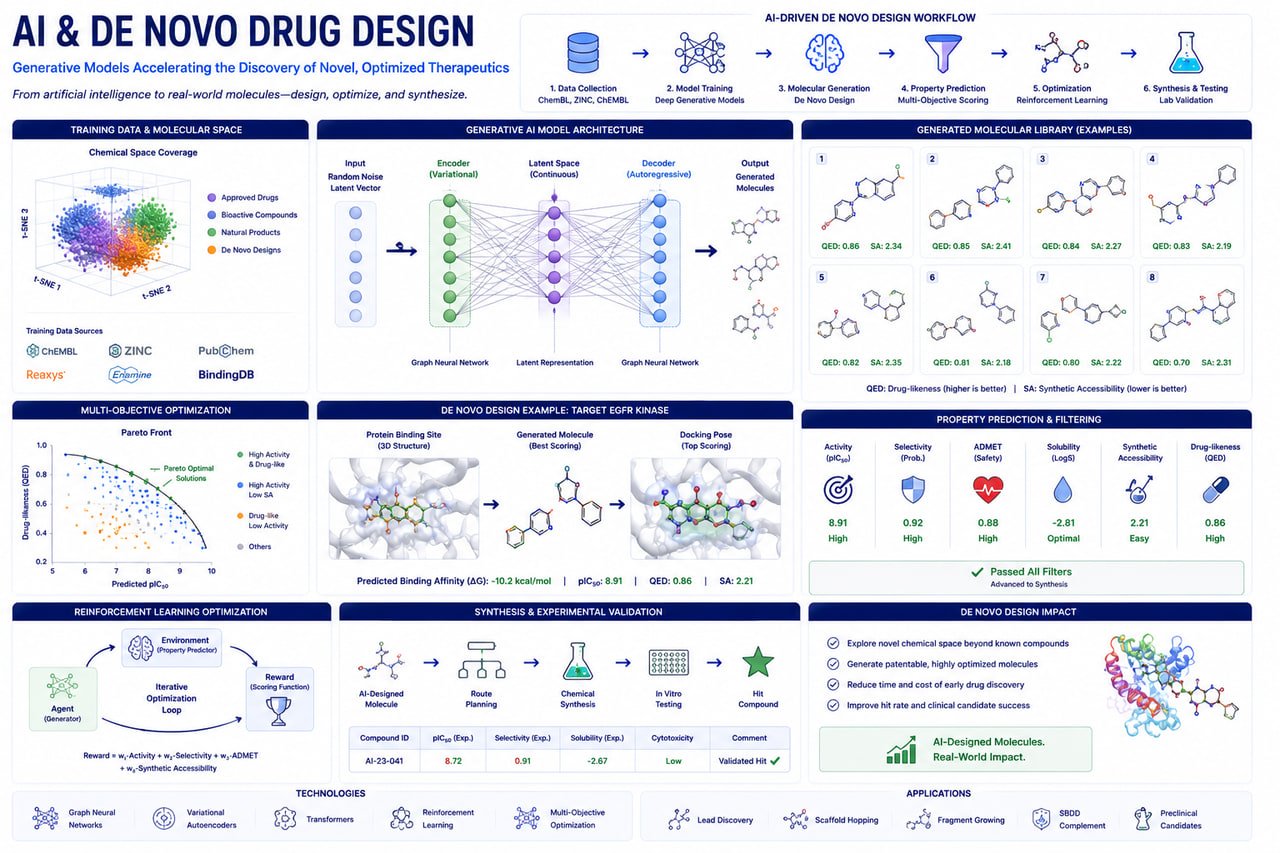
AI Drug Discovery & De Novo Design

RASA Life Science Informatics provides advanced AI Drug Discovery & De Novo Design services to help pharmaceutical companies, biotechnology organizations, CROs, and research institutions accelerate the discovery of novel therapeutic candidates. By integrating artificial intelligence (AI), machine learning (ML), cheminformatics, structural biology, and computational drug design, we enable the rapid generation, optimization, and prioritization of drug-like molecules with enhanced efficacy, selectivity, and developability.

Our AI-driven platforms leverage state-of-the-art generative models, molecular representation learning, and predictive analytics to design novel compounds beyond existing chemical space. From target-focused molecule generation to lead optimization and multi-parameter candidate selection, our workflows reduce discovery timelines and improve hit-to-lead success rates.

We support diverse therapeutic areas including oncology, neuroscience, infectious diseases, autoimmune disorders, metabolic diseases, rare diseases, and precision medicine programs.

Service Offerings

What We Offer

AI-Driven Molecule Generation

  • De novo molecular design using generative AI
  • Novel scaffold generation
  • Lead-like and drug-like molecule design
  • Target-focused compound generation

Machine Learning-Based Drug Discovery

  • Molecular property prediction
  • Activity and potency prediction
  • Binding affinity estimation
  • Multi-parameter optimization

Generative Chemistry Workflows

  • Variational Autoencoders (VAE)
  • Generative Adversarial Networks (GAN)
  • Diffusion Models
  • Reinforcement Learning-based molecule optimization

Lead Optimization

  • Structure-guided lead refinement
  • SAR-driven optimization
  • Synthetic accessibility assessment
  • Drug-likeness optimization

ADMET & Developability Prediction

  • Pharmacokinetic property prediction
  • Toxicity risk assessment
  • Solubility prediction
  • Early-stage developability screening
Capabilities

Key Features

AI-Powered Drug Candidate Generation
Novel Chemical Space Exploration
Multi-Parameter Lead Optimization
Target-Specific Molecule Design
ADMET-Aware Candidate Selection
Scalable Cloud-Based Infrastructure
Reproducible Computational Pipelines
Applications

Applications

Novel Drug Discovery

Generation of first-in-class therapeutic candidates for emerging biological targets.

Lead Optimization

AI-assisted refinement of hit compounds to improve potency and selectivity.

Drug Repurposing

Identification of alternative therapeutic applications for existing compounds.

Precision Medicine

Design of patient-specific therapeutic candidates based on molecular profiles.

Multi-Target Drug Discovery

Development of compounds capable of modulating multiple disease pathways.

Technology

Technologies & Platforms

Artificial Intelligence & Machine Learning

DeepChem
TensorFlow
PyTorch
Scikit-Learn
RDKit

Generative AI Models

Variational Autoencoders (VAE)
Generative Adversarial Networks (GAN)
Diffusion Models
Reinforcement Learning Models

Drug Discovery Platforms

ChEMBL
DrugBank
ZINC Database
PubChem
BindingDB

Infrastructure

Docker
Nextflow
AWS
Google Cloud
HPC Clusters
Deliverables

Deliverables

AI-Generated Molecule Libraries

Novel compound datasets
Drug-like candidate libraries
Optimized lead series

Predictive Modeling Reports

Activity prediction reports
Binding affinity predictions
ADMET profiling reports

Scientific Visualizations

Chemical space maps
PCA projections
Molecular similarity networks
Candidate ranking dashboards

Publication-Ready Reports

Compound prioritization reports
Lead optimization summaries
Scientific presentations and figures
Why RASA

Why Choose RASA?

AI-Assisted Bioinformatics

Machine learning-enabled workflows for biomarker discovery, variant prioritization, and predictive genomics.

Multi-Platform Expertise

Support for Illumina, Oxford Nanopore, PacBio HiFi, and 10x Genomics platforms.

End-to-End Analysis

From raw sequencing data to biological interpretation and publication-ready reports.

Cloud-Ready Infrastructure

Deployable on AWS, Google Cloud, HPC clusters, and secure on-premise environments.

Reproducible Workflows

Built using Nextflow, Snakemake, Docker, and Singularity for enterprise-grade bioinformatics operations.

Service FAQ

Frequently Asked Questions

AI Drug Discovery uses artificial intelligence, machine learning, deep learning, and computational chemistry to accelerate the identification, design, and optimization of therapeutic compounds. By analyzing large biological and chemical datasets, AI models can predict molecular properties, identify drug targets, generate novel compounds, and prioritize candidates for experimental validation.

De Novo Drug Design is the process of creating entirely new molecular structures computationally rather than screening existing compounds. AI-driven de novo design enables researchers to generate novel drug candidates optimized for potency, selectivity, safety, and pharmacokinetic properties.

RASA Life Science Informatics offers:
AI-Assisted Target Identification
Generative AI Molecule Design
De Novo Drug Design
Lead Generation
Lead Optimization
Scaffold Hopping
Fragment-Based Drug Design
Multi-Parameter Optimization
AI-Powered Virtual Screening
Drug Repurposing
ADMET Prediction
QSAR Modeling

Artificial Intelligence helps researchers:
Reduce hit identification time
Prioritize promising compounds
Predict biological activity
Improve ADMET properties
Generate novel molecules
Optimize lead compounds
Reduce experimental screening costs
Accelerate decision-making
AI can evaluate millions of compounds significantly faster than traditional experimental approaches.

Yes. Generative AI models can create novel chemical structures that do not exist in current databases. These molecules can be optimized for specific biological targets, drug-likeness, toxicity profiles, and pharmacokinetic properties before experimental testing.

Generative AI uses deep learning models to design new molecular structures based on desired biological and chemical properties.
Applications include:
Novel Molecule Generation
Lead Optimization
Scaffold Hopping
Fragment Linking
Molecular Property Optimization
Multi-Target Drug Design

Scaffold Hopping is a computational drug design strategy that identifies structurally different molecules with similar biological activity. AI models help discover alternative chemical scaffolds that may offer improved potency, patentability, safety, or pharmacokinetic properties.

Lead Optimization uses machine learning models to improve the properties of promising compounds by predicting:
Potency
Selectivity
Solubility
Permeability
Toxicity
Metabolic Stability
Bioavailability
This helps researchers prioritize compounds with a higher probability of success.

Multi-Parameter Optimization simultaneously optimizes multiple molecular properties during drug design.
Common optimization parameters include:
Target Activity
ADMET Properties
Toxicity
Solubility
Selectivity
Molecular Weight
Synthetic Accessibility
AI models can balance these competing objectives to identify high-quality lead compounds.

Yes. AI models can predict:
Absorption
Distribution
Metabolism
Excretion
Toxicity
ADMET prediction helps identify potential safety liabilities early in the drug discovery process and reduces costly experimental failures.

AI-powered drug repurposing identifies new therapeutic applications for approved or investigational drugs by analyzing biological pathways, disease networks, molecular interactions, and genomic data.
This approach can significantly reduce development costs and timelines compared to traditional drug discovery.

Our AI workflows may utilize:
Chemical Libraries
Molecular Structures
Bioactivity Databases
Genomics Data
Transcriptomics Data
Proteomics Data
Clinical Datasets
Drug Databases
Scientific Literature
Multi-Omics Datasets

Our AI Drug Discovery platform may utilize:
Artificial Intelligence & Machine Learning
DeepChem
TensorFlow
PyTorch
Scikit-Learn
XGBoost
Graph Neural Networks (GNNs)
Cheminformatics
RDKit
Mordred
Open Babel
Drug Discovery Platforms
DeepPurpose
ChemBERTa
MolBERT
DeepDock
Structural Biology
AlphaFold
AutoDock Vina
GROMACS

Yes. Generated compounds can be evaluated using:
Molecular Docking
Virtual Screening
Molecular Dynamics Simulations
QSAR Modeling
ADMET Prediction
Toxicity Assessment
These analyses help prioritize compounds before experimental testing.

Typical deliverables include:
Novel Molecule Libraries
Lead Candidate Rankings
AI Prediction Reports
ADMET Profiles
QSAR Reports
Molecular Docking Results
Virtual Screening Reports
Drug Repurposing Reports
Chemical Space Analysis
Publication-Ready Figures
Comprehensive Scientific Reports

Our AI workflows support:
Oncology
Neuroscience
Infectious Diseases
Autoimmune Disorders
Rare Diseases
Cardiometabolic Diseases
Antimicrobial Discovery
Precision Medicine Programs

RASA combines expertise in artificial intelligence, cheminformatics, structural biology, molecular modeling, and computational drug discovery to deliver scalable, reproducible, and scientifically rigorous AI-driven drug design solutions. Our integrated workflows accelerate lead generation, optimize molecular properties, and help researchers transform biological insights into high-confidence therapeutic candidates.
SEO Keywords Covered
AI Drug Discovery Services
De Novo Drug Design Services
Generative AI Drug Discovery
AI Molecule Generation
AI Lead Optimization
Drug Repurposing Services
Machine Learning Drug Discovery
Computational Drug Design
AI-Powered Drug Development
Generative Chemistry
AI ADMET Prediction
Multi-Parameter Optimization Drug Design
AI Drug Design Company
Artificial Intelligence in Drug Discovery

Ready to partner with a trusted bioinformatics company in India?

Get in touch with our team in Pune, India to discuss sample sizes, platform details, and custom bioinformatics pipeline configurations for your research program.

Start a Project